LD3 Container Dimensions, Volume and Weight Limits Explained
LD3 (AKE) dimensions in cm and inches, the contour shape, usable volume, max gross weight, what fits inside, and how the LD3 differs from the lower LD3-45.
Air cargo · · 6 min read
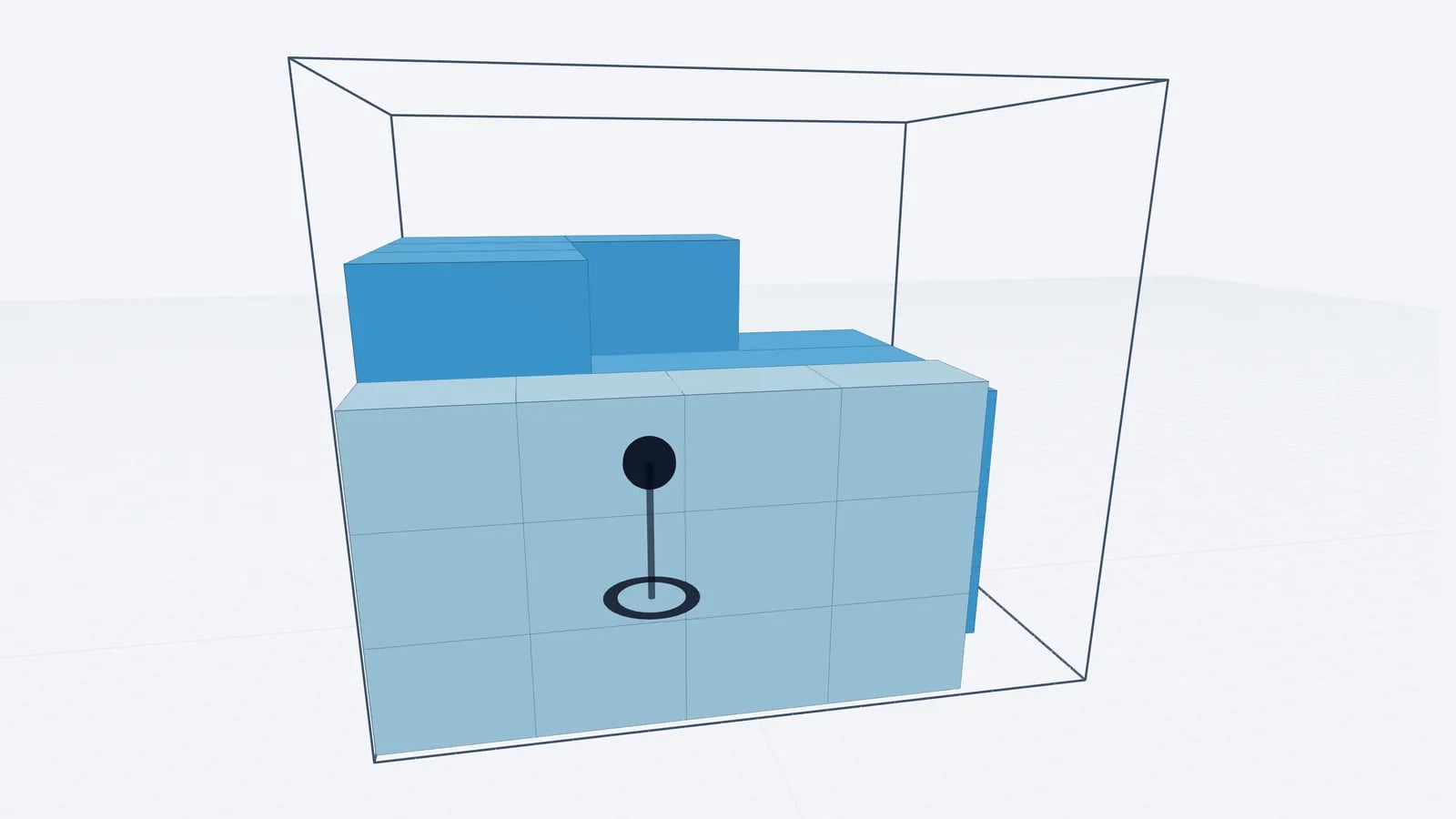
An LD3 (IATA code AKE) container measures about 156 × 153 cm at the base, 201 cm wide at the top and 163 cm high (61.5 × 60.4 in base, 79 in overall width, 64 in high). It holds roughly 4.3 m³ and is typically rated to a maximum gross weight of 1,588 kg (3,500 lb), including its own tare. The LD3-45 (AKH) is a lower version, about 114 cm high, made for A320-family aircraft.
These are the commonly published outside figures. Inside dimensions are a few centimetres smaller, and they differ slightly between manufacturers and between aluminium and composite units. If a piece is tight, ask the handler for the inside size of the actual unit.
LD3 dimensions at a glance
Measurement: Base width
- Metric (approx.)
- 156 cm
- Imperial (approx.)
- 61.5 in
Measurement: Depth (front to back)
- Metric (approx.)
- 153 cm
- Imperial (approx.)
- 60.4 in
Measurement: Overall width at the top
- Metric (approx.)
- 201 cm
- Imperial (approx.)
- 79 in
Measurement: Height
- Metric (approx.)
- 163 cm
- Imperial (approx.)
- 64 in
Measurement: Internal volume
- Metric (approx.)
- about 4.3 m³
- Imperial (approx.)
- about 150 to 155 cu ft
Measurement: Max gross weight
- Metric (approx.)
- 1,588 kg
- Imperial (approx.)
- 3,500 lb
Measurement: Tare weight
- Metric (approx.)
- about 60 to 100 kg
- Imperial (approx.)
- about 130 to 220 lb
Measurement: Usable payload
- Metric (approx.)
- about 1,490 to 1,530 kg
- Imperial (approx.)
- about 3,280 to 3,370 lb
| Measurement | Metric (approx.) | Imperial (approx.) |
|---|---|---|
| Base width | 156 cm | 61.5 in |
| Depth (front to back) | 153 cm | 60.4 in |
| Overall width at the top | 201 cm | 79 in |
| Height | 163 cm | 64 in |
| Internal volume | about 4.3 m³ | about 150 to 155 cu ft |
| Max gross weight | 1,588 kg | 3,500 lb |
| Tare weight | about 60 to 100 kg | about 130 to 220 lb |
| Usable payload | about 1,490 to 1,530 kg | about 3,280 to 3,370 lb |
The usable payload is simply the max gross minus the tare of the unit you are given. A lightweight composite LD3 leaves a little more for cargo than an older aluminium one.
The contour: why the LD3 is not a box
An LD3 sits in the lower hold, where the fuselage curves inwards towards the floor. To use that space, one side of the container is cut away at an angle: the floor is 156 cm wide, but the upper part widens to 201 cm, overhanging the base on one side. That sloped side is the contour.
Two LD3s are loaded side by side across the hold, each with its overhang towards the aircraft skin. In the middle, their straight sides face each other.
For planning, think of the LD3 as two spaces: a rectangular block over the 156 × 153 cm base, full height, and a wedge-shaped wing above the slope. The rectangular block alone is about 1.56 × 1.53 × 1.63 m = 3.89 m³ measured on the outside. The published 4.3 m³ also counts the wing, but the wing has a sloped floor, so only cartons small enough to sit above the slope fit there.
Tip
Keep a few small cartons or soft packages aside to fill the contour wing last. Large cartons placed in the rectangular block first, small ones in the wing on top: that is how experienced handlers get close to the published volume.
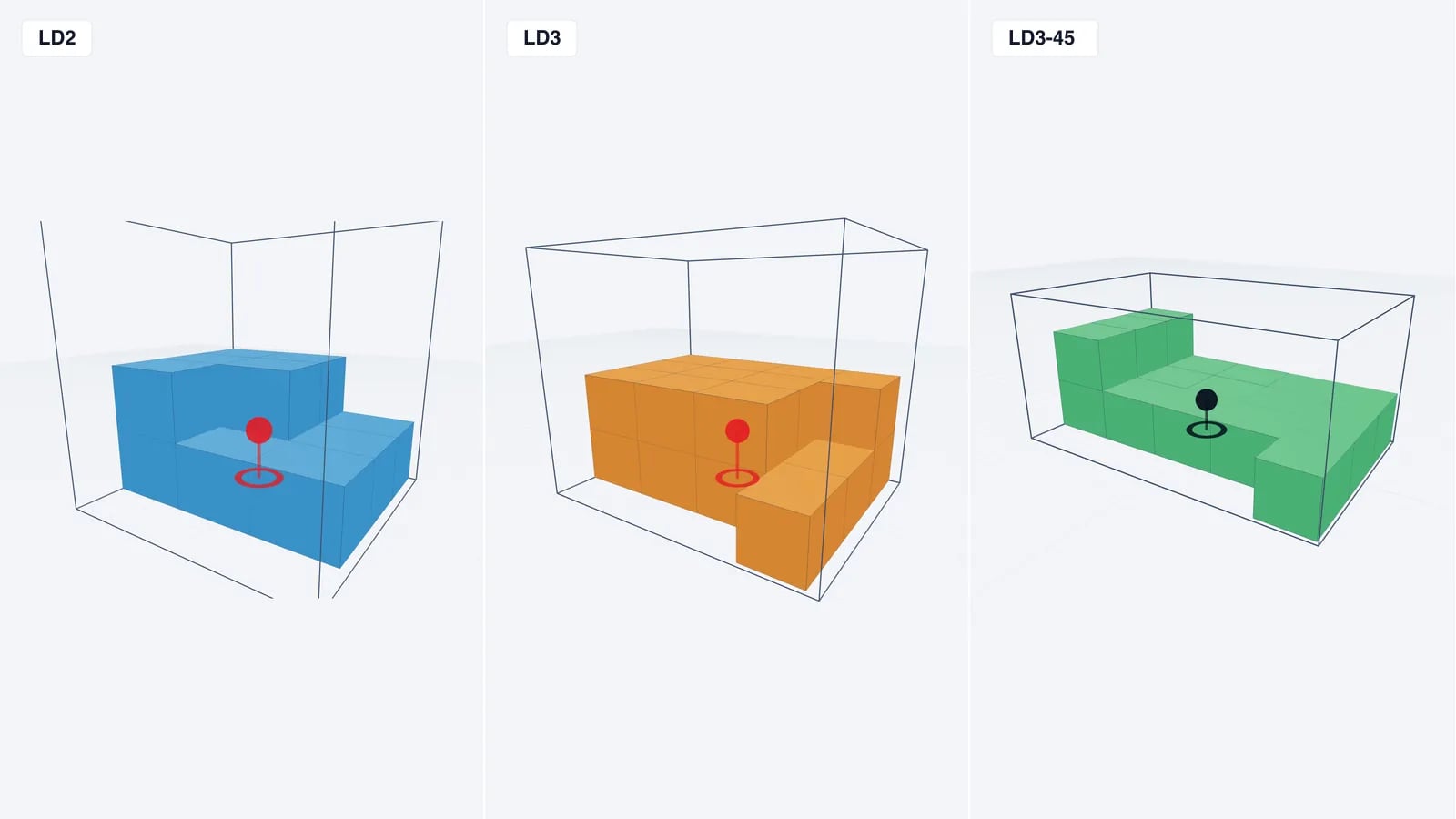
LD3 vs LD3-45 vs LD2
Base width × depth
- LD3 (AKE)
- 156 × 153 cm
- LD3-45 (AKH)
- 156 × 153 cm
- LD2 (DPE)
- 119 × 153 cm
Top width
- LD3 (AKE)
- 201 cm
- LD3-45 (AKH)
- 244 cm
- LD2 (DPE)
- 156 cm
Height
- LD3 (AKE)
- 163 cm
- LD3-45 (AKH)
- 114 cm
- LD2 (DPE)
- 163 cm
Volume (approx.)
- LD3 (AKE)
- 4.3 m³
- LD3-45 (AKH)
- 3.6 m³
- LD2 (DPE)
- 3.4 m³
Max gross (typical)
- LD3 (AKE)
- 1,588 kg
- LD3-45 (AKH)
- 1,134 kg
- LD2 (DPE)
- 1,225 kg
Contour
- LD3 (AKE)
- One side
- LD3-45 (AKH)
- Both sides
- LD2 (DPE)
- One side
Typical aircraft
- LD3 (AKE)
- A330, A350, B777, B787, B747
- LD3-45 (AKH)
- A320, A321
- LD2 (DPE)
- B767
| LD3 (AKE) | LD3-45 (AKH) | LD2 (DPE) | |
|---|---|---|---|
| Base width × depth | 156 × 153 cm | 156 × 153 cm | 119 × 153 cm |
| Top width | 201 cm | 244 cm | 156 cm |
| Height | 163 cm | 114 cm | 163 cm |
| Volume (approx.) | 4.3 m³ | 3.6 m³ | 3.4 m³ |
| Max gross (typical) | 1,588 kg | 1,134 kg | 1,225 kg |
| Contour | One side | Both sides | One side |
| Typical aircraft | A330, A350, B777, B787, B747 | A320, A321 | B767 |
The LD3-45 has the same base, but because narrow-body holds are low and wide, it is only 114 cm (45 in) high and has wings on both sides. Pieces taller than about 105 to 110 cm inside will not go in. If your cargo moves on a narrow-body leg anywhere in its routing, plan to the LD3-45 height.
The LD2 is a narrower unit for the Boeing 767 lower deck. An LD3 fits a 767, but the LD2 is the dedicated size. For an overview of all container and pallet types, see ULD types explained.
Is an LD3 weight-limited or volume-limited?
Air freight is charged at the higher of actual and volumetric weight, using the IATA divisor of 6,000 cm³ per kg. That works out at about 167 kg per cubic metre. A full LD3 of 4.3 m³ therefore has a volumetric weight of about 4.3 × 167 = 717 kg.
Compare that with the roughly 1,500 kg of payload. To reach the weight limit before you run out of space, your cargo would need an average density of about 1,500 ÷ 4.3 = 349 kg/m³. Most general cargo (electronics, clothing, spare parts in cartons) is lighter than that, so in practice an LD3 usually runs out of space before it runs out of weight. Dense cargo such as metal parts, liquids or printed matter can hit the weight limit first.
That is why the shape and size of your cartons matter so much: wasted volume is paid for. The arithmetic of chargeable weight is covered in air cargo chargeable weight.
Worked example: cartons in an LD3
Say you have cartons of 60 × 40 × 40 cm, 12 kg each. Suppose the handler tells you the rectangular part of the unit measures about 148 × 146 cm inside, with 155 cm of clear height (a hypothetical but realistic set of inside figures).
- 1Simple flat layer: lay each carton on its 60 × 40 face with the 60 cm side across the width. That gives 2 across (120 cm) and 3 deep (120 cm), so 6 per layer, wasting strips of 28 cm and 26 cm.
- 2Mixed flat layer: across the 148 cm width, use one column with the 60 cm side across and next to it two columns with the 40 cm side across (60 + 40 + 40 = 140 cm). The first column takes 3 cartons deep (120 cm), the other two take 2 each (60 + 60 = 120 cm). That is 7 per layer.
- 3Flat layers are 40 cm high: 155 ÷ 40 = 3 layers, so 21 cartons, with 35 cm of height unused.
- 4Standing layer: on the 40 × 40 end the cartons are 60 cm high and fit 3 × 3 = 9 per layer (120 × 120 cm).
- 5Combine them: one standing layer (60 cm) plus two mixed flat layers (80 cm) is 140 cm high and holds 9 + 7 + 7 = 23 cartons, 276 kg and 2.21 m³.
Same unit, same cartons: 18 with the obvious pattern of 6 per layer, 23 with a little thought, and that is before any small pieces go into the contour wing. Turning cartons only works when the contents allow it, so check orientation marks first. How carton size itself changes the count and the bill is covered in packing for air freight.
A 3D planner makes this trial and error quick. EveryLoading has LD3, LD3-45 and LD2 presets under Air ULD. The presets are modelled as rectangular spaces using the overall dimensions, so for a conservative plan enter a custom size with the inside base measurements and treat the contour wing as a bonus.
Frequently asked questions
How many cubic metres is an LD3?
About 4.3 m³ of internal volume according to most published specifications. Real cartons rarely fill all of it because of the sloped contour side.
What is the maximum weight of an LD3?
The typical maximum gross weight is 1,588 kg (3,500 lb), including the container itself. After tare, roughly 1,490 to 1,530 kg is left for cargo, depending on the unit.
Is AKE the same as LD3?
Yes. AKE is the IATA type code and LD3 is the common name. The code on the side of the unit, such as AKE 12345 XX, also gives the serial number and owner.
What is the tallest piece that fits in an LD3?
Inside clear height is a few centimetres under the 163 cm outside height, so plan pieces at about 155 cm or less and confirm with the handler. For an LD3-45, plan at about 105 to 110 cm.
Keep reading
Air cargo · · 7 min read
ULD Types Explained: LD3, LD2, LD3-45, PMC and PAG Pallets
A practical guide to air cargo ULD types: LD3, LD3-45, LD2, LD6, PMC and PAG pallets, with typical dimensions, max gross weights and the aircraft that use them.
Read article
Air cargo · · 5 min read
Air vs Sea Freight: When to Switch Mode and How Planning Differs
Air vs sea freight compared for planners: how each mode charges, when air pays, density break-evens, ULDs vs containers, consolidation and a worked example.
Read article
Air cargo · · 6 min read
Air Freight Packaging: How to Pack Cargo That Flies Cheaper
Air freight packaging done right: carton strength, sizes that suit ULDs, pallets and ISPM 15, labelling, and practical ways to cut volumetric weight.
Read article