IBC Transport: Planning Drums and IBC Loads on a Trailer
IBC transport planning: how many IBCs and 200 L drums fit, weight by product density, stacking from the UN marking, and ADR points to check before dispatch.
Industry guides · · 5 min read
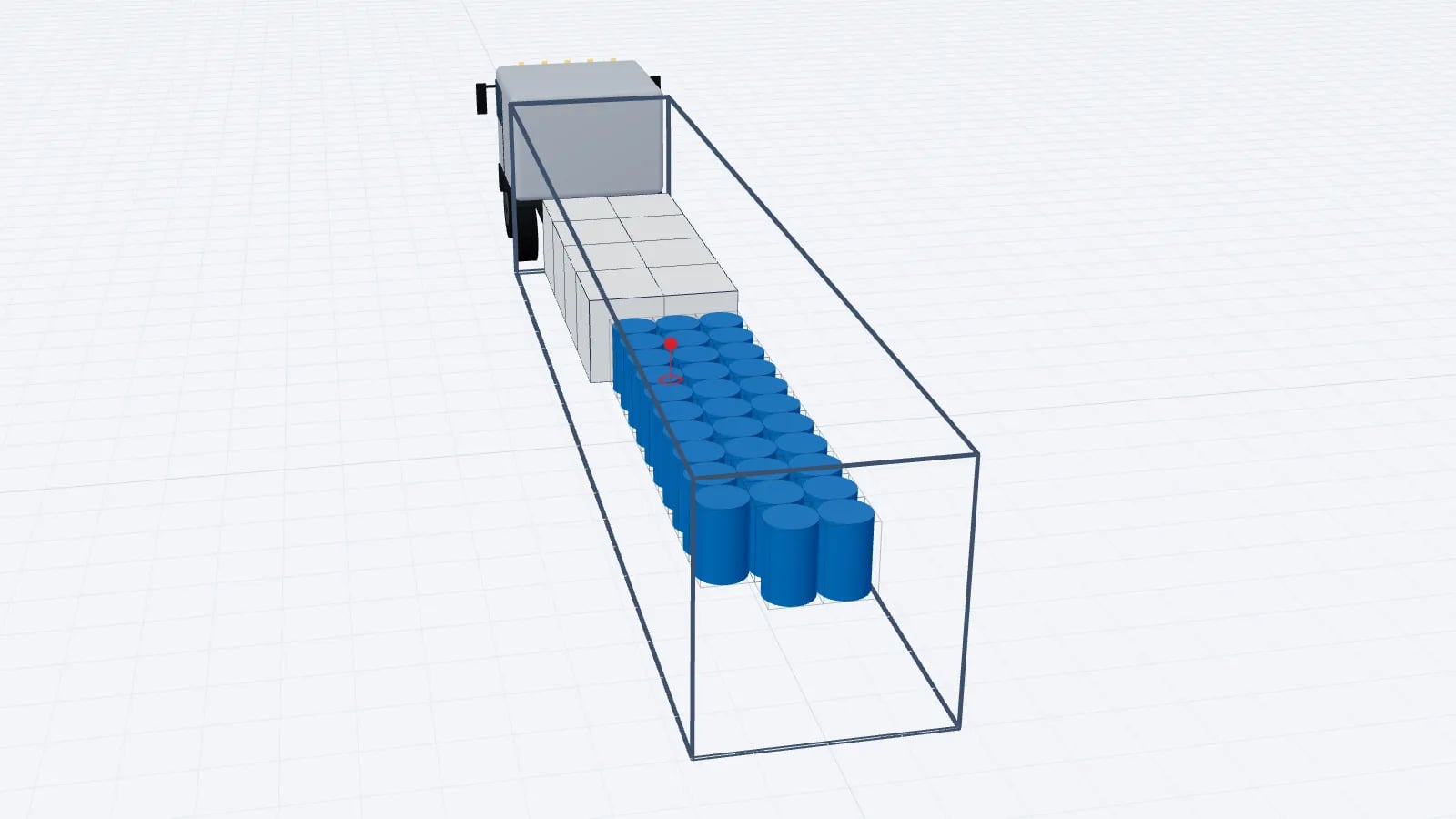
IBC transport is weight-limited almost every time. A 1,000-litre IBC of a water-like liquid weighs a little over a tonne, so a semitrailer runs out of payload before its floor is full. Planning means working out the weight from the product density, placing the IBCs or drums tightly with no gaps, checking stacking against the packaging marking, and, for dangerous goods, applying ADR. This article is general guidance; always check the current ADR text or your dangerous goods safety adviser.
Typical units and their weights
Unit: IBC, 1,000 L
- Typical footprint
- About 1200 × 1000 mm, around 1.15 m high
- Filled weight
- Capacity × density + tare (often around 50–70 kg)
Unit: Steel drum, 200–216 L
- Typical footprint
- About 585–600 mm diameter, about 880 mm high
- Filled weight
- Capacity × density + tare (roughly 15–25 kg)
Unit: 4 drums on a pallet
- Typical footprint
- Commonly a 1200 × 1200 mm pallet
- Filled weight
- Four drums plus pallet
Unit: 2 drums on a Euro pallet
- Typical footprint
- 1200 × 800 mm
- Filled weight
- Two drums plus pallet
| Unit | Typical footprint | Filled weight |
|---|---|---|
| IBC, 1,000 L | About 1200 × 1000 mm, around 1.15 m high | Capacity × density + tare (often around 50–70 kg) |
| Steel drum, 200–216 L | About 585–600 mm diameter, about 880 mm high | Capacity × density + tare (roughly 15–25 kg) |
| 4 drums on a pallet | Commonly a 1200 × 1200 mm pallet | Four drums plus pallet |
| 2 drums on a Euro pallet | 1200 × 800 mm | Two drums plus pallet |
Use the density of the actual product, not water. A product at 1.3 kg/L makes a 1,000-litre IBC weigh about 1,360 kg with tare, more than a quarter heavier than the same IBC of water.
Worked example: how many IBCs fit
Say you have IBCs of 1200 × 1000 mm and a semitrailer with a 13.6 × 2.45 m floor and 24,000 kg payload.
By floor space: two IBCs abreast with the 1.2 m side across the trailer (2.4 m), and the 1.0 m side along it, give rows of 1.0 m. 13 rows fit in 13.0 m, so 26 IBCs single-tier.
By weight at density 1.0: each IBC weighs about 1,000 kg + 60 kg tare = 1,060 kg. 24,000 / 1,060 = 22.6, so the limit is 22 IBCs (23,320 kg). A 23rd would make it 24,380 kg.
By weight at density 1.3: each weighs about 1,360 kg. 24,000 / 1,360 = 17.6, so 17 IBCs (23,120 kg).
Product density: 0.8 kg/L
- Weight per IBC (60 kg tare)
- 860 kg
- Max IBCs at 24,000 kg
- 27, capped at 26 by floor
- Floor positions used of 26
- 26
Product density: 1.0 kg/L
- Weight per IBC (60 kg tare)
- 1,060 kg
- Max IBCs at 24,000 kg
- 22
- Floor positions used of 26
- 22
Product density: 1.3 kg/L
- Weight per IBC (60 kg tare)
- 1,360 kg
- Max IBCs at 24,000 kg
- 17
- Floor positions used of 26
- 17
Product density: 1.8 kg/L
- Weight per IBC (60 kg tare)
- 1,860 kg
- Max IBCs at 24,000 kg
- 12
- Floor positions used of 26
- 12
| Product density | Weight per IBC (60 kg tare) | Max IBCs at 24,000 kg | Floor positions used of 26 |
|---|---|---|---|
| 0.8 kg/L | 860 kg | 27, capped at 26 by floor | 26 |
| 1.0 kg/L | 1,060 kg | 22 | 22 |
| 1.3 kg/L | 1,360 kg | 17 | 17 |
| 1.8 kg/L | 1,860 kg | 12 | 12 |
Where fewer IBCs than floor positions are allowed, the empty positions need to be spread so the axle loads stay legal and the gaps need blocking. Liquids in partly-empty positions are still heavy cargo: a block of 17 IBCs pushed to the headboard puts the whole 23 t forward. Weight distribution in a trailer covers how to place a heavy partial load.
Stacking IBCs and drums
Whether an IBC can be stacked is shown on its UN packaging marking, which includes the stacking test load. IBCs made for stacking carry a symbol with the maximum permitted stacking load; others carry a symbol showing they must not be stacked. The planner should take the stack rule from the marking or the shipper, not assume it.
- Stacked IBCs need a rated top frame or pallet that sits squarely on the one below.
- Stacking does not help if the trailer is already weight-limited, which it usually is with full IBCs.
- It can help with light or partly-filled units, or empties on the return leg.
- Drums on pallets are often stacked in warehouses; in transport, check the drum and pallet ratings and secure each tier.
ADR awareness for planners
When the goods are dangerous goods, ADR applies in road transport across Europe and in many neighbouring countries. ADR is revised every two years, so always use the current edition. Points that affect the load plan include:
- Mixed loading prohibitions (ADR 7.5.2): some classes may not be loaded together in the same vehicle, depending on the labels.
- Segregation from food and feed: toxic and some other goods must be kept apart from foodstuffs.
- Exemptions by quantity (ADR 1.1.3.6): below set thresholds some requirements are relaxed; the points calculation depends on the transport category.
- Securing (ADR 7.5.7): packages must be secured to prevent movement, in line with recognised standards such as EN 12195-1.
- Documents, vehicle marking, equipment and driver training: not part of the plan itself, but the plan should state what is on board so these can be checked.
Good to know
This is a summary for planning awareness, not a compliance check. A dangerous goods safety adviser (DGSA) or the shipper's DG department should confirm classification, segregation and documentation.
Securing liquids in packages
- Load tight. IBCs and drum pallets should form a solid block from the headboard with no gaps. Any gap must be filled or blocked.
- Block against the headboard and use anti-slip mats; heavy liquids create large forces in braking.
- Protect valves and drum bungs from straps and from neighbouring units.
- Check for leaks before loading. A leaking unit should not be loaded.
More on restraint methods is in load securing basics.
A short checklist
- 1Get the product, density, quantity, UN number and class (if dangerous) for each line.
- 2Calculate the filled weight of every IBC or drum pallet, and the total against payload.
- 3Check mixed loading and food segregation for dangerous goods with the current ADR.
- 4Plan the layout: tight block, stacking only where the marking allows, gaps spread and blocked.
- 5Check the axle estimate and plan securing.
- 6Record the plan with the transport document.
In EveryLoading each IBC type is a row with its real filled weight and a non-stackable flag where needed, and the optimizer stops at the payload; weight and axle loads explains the estimate. ADR checks are not part of the planner, so do them separately.
Frequently asked questions
How many IBCs fit on a semitrailer?
Up to 26 by floor space in a 13.6 m trailer, single tier. With a water-like product and about 24 t payload the weight limit is around 22.
How much does a full IBC weigh?
Capacity times product density plus the tare. A 1,000-litre IBC of a product at 1.0 kg/L with a 60 kg tare weighs about 1,060 kg.
Can IBCs be stacked in a truck?
Only if the UN marking and the shipper allow it, and the frames sit squarely on each other. Full IBCs usually reach the payload limit first anyway.
Can different chemicals go on the same truck?
It depends on their ADR classes and labels. ADR 7.5.2 lists mixed loading prohibitions, and some goods must be kept apart from food; check the current edition or a DGSA.
Keep reading
Industry guides · · 5 min read
Fresh Produce Transport: Planning Crates, Bins and Reefers
Fresh produce transport planning: crates and bins, temperature and ventilation in general terms, product compatibility, airflow and when produce weighs out.
Read article
Industry guides · · 6 min read
Beverage Pallet Loading: Plan for Weight Before Volume
Beverage pallets run out of payload long before the trailer is full. How to work out the pallet count, spread the weight over the axles and decide on stacking.
Read article
Industry guides · · 5 min read
Removal Truck Loading: Survey, Size and Load a Household Move
Removal truck loading for movers: turning a volume survey into the right vehicle, loading order for furniture and boxes, protection, and shared-load moves.
Read article