Weight Distribution in a Trailer: Axle Loads Made Simple
Where you put heavy cargo decides the load on each axle. Learn how trailer weight distribution works, how to estimate axle loads and how to avoid overloading.
Load planning basics · · 6 min read
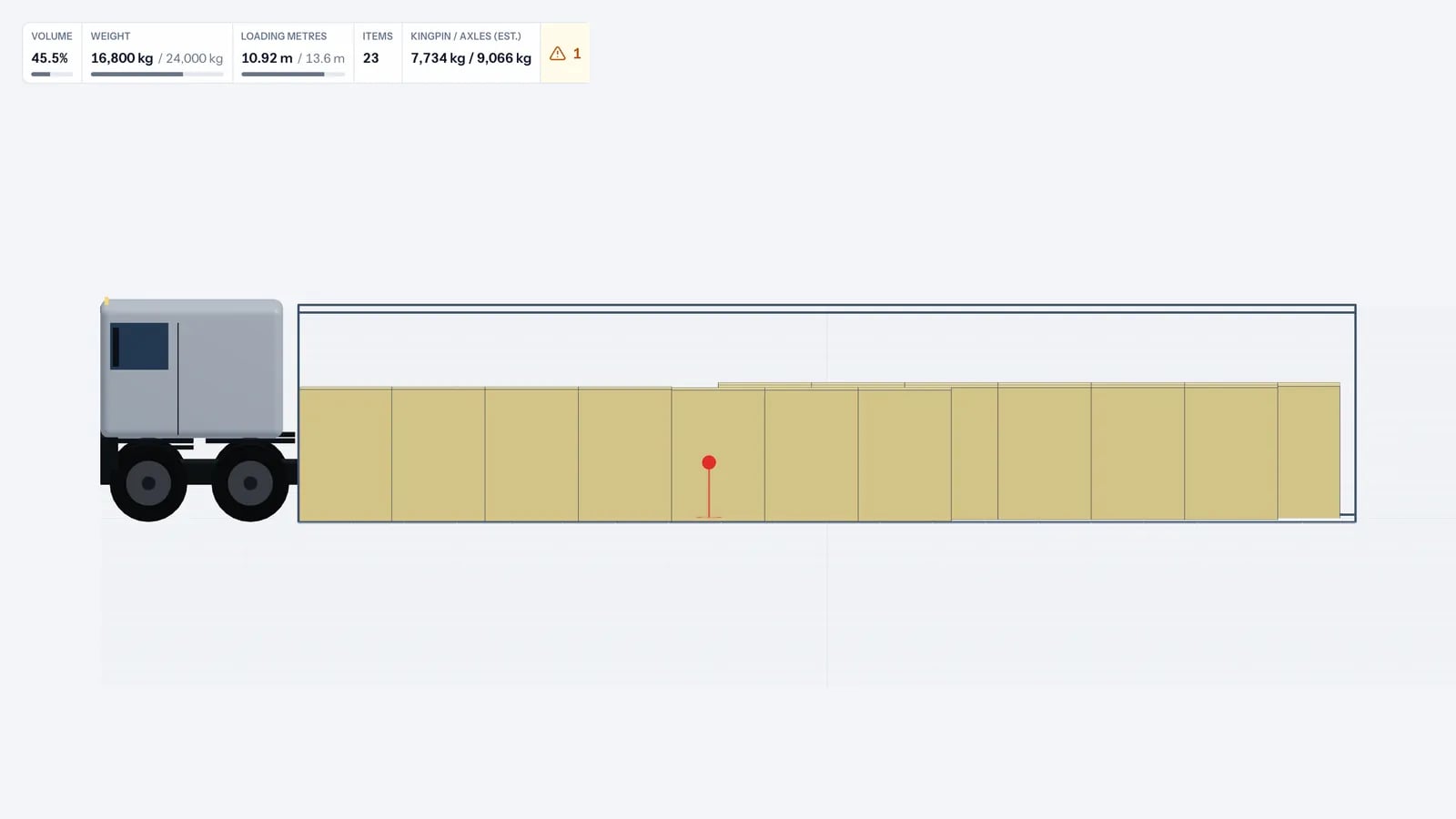
Weight distribution in a trailer is about where the cargo's weight sits along the length and across the width. On a semitrailer the load is shared between the kingpin (carried by the tractor) and the trailer axles, so moving heavy goods forward loads the tractor, and moving them back loads the trailer axles. A good plan spreads heavy items evenly, keeps them low and on the centre line, and checks every axle group against its limit, not just the total weight.
A truck can be under its gross weight limit and still be overloaded on one axle. That is a common reason for fines at roadside checks, and it also hurts braking, steering and tyre wear.
Why weight distribution matters
- Legal limits per axle. In most EU countries, Directive 96/53/EC sets 11.5 t for a single drive axle and limits for tandem and tri-axle groups that depend on axle spacing. A tri-axle trailer group with axles spaced more than 1.3 m and up to 1.4 m apart is commonly limited to 24 t. National rules differ and some countries enforce lower or higher limits domestically, so check the rules where you drive.
- Steering and traction. Too little weight on the tractor's drive axle means poor traction in wet or icy conditions; too little on the steer axle makes steering light.
- Braking and stability. A load concentrated at one end or one side changes how the vehicle brakes and corners and raises the risk of a rollover.
- Wear and damage. Overloaded axles wear tyres, suspension and the trailer floor faster.
Good to know
This article explains the principle. Limits depend on the vehicle, its registration and national law, and only a weighbridge gives real axle loads. Use estimates to plan, then weigh when you are close to a limit. For the legal overview, see axle weight limits in the EU.
How a semitrailer shares the load
Think of the trailer as a beam resting on two supports: the kingpin at the front and the centre of the trailer axle group at the back. Cargo weight is shared between them in proportion to its position, like a see-saw:
- Share on the trailer axles = cargo weight × (distance from kingpin to the cargo's centre of gravity) ÷ (distance from kingpin to axle group centre).
- Share on the kingpin = cargo weight − share on the trailer axles.
The kingpin share then goes to the tractor, where it is split between the steer axle and the drive axle depending on where the fifth wheel sits. Moving the fifth wheel forward puts more of the kingpin load on the steer axle. Cargo behind the axle group lifts load off the kingpin.
Worked example: one load, three placements
Say a curtainsider has its kingpin 1.0 m behind the front wall of the load space and the centre of its tri-axle group 9.6 m behind the front wall. The distance between the supports is 8.6 m. These positions are hypothetical; measure your own trailer or take them from the manufacturer's drawing. The cargo is 22,000 kg.
Placement: Spread evenly over 13.2 m
- Cargo CoG from front wall
- 6.6 m
- Distance from kingpin
- 5.6 m
- Trailer axles
- 22,000 × 5.6 ÷ 8.6 = 14,326 kg
- Kingpin
- 7,674 kg
Placement: Bunched at the front
- Cargo CoG from front wall
- 4.0 m
- Distance from kingpin
- 3.0 m
- Trailer axles
- 22,000 × 3.0 ÷ 8.6 = 7,674 kg
- Kingpin
- 14,326 kg
Placement: Bunched at the rear
- Cargo CoG from front wall
- 9.0 m
- Distance from kingpin
- 8.0 m
- Trailer axles
- 22,000 × 8.0 ÷ 8.6 = 20,465 kg
- Kingpin
- 1,535 kg
| Placement | Cargo CoG from front wall | Distance from kingpin | Trailer axles | Kingpin |
|---|---|---|---|---|
| Spread evenly over 13.2 m | 6.6 m | 5.6 m | 22,000 × 5.6 ÷ 8.6 = 14,326 kg | 7,674 kg |
| Bunched at the front | 4.0 m | 3.0 m | 22,000 × 3.0 ÷ 8.6 = 7,674 kg | 14,326 kg |
| Bunched at the rear | 9.0 m | 8.0 m | 22,000 × 8.0 ÷ 8.6 = 20,465 kg | 1,535 kg |
These are cargo-only figures. The trailer's own weight also rests on its axles and kingpin, and the tractor's weight sits on its own axles.
- Even spread: about 14.3 t of cargo on the trailer axles plus part of the trailer's tare. Likely within a 24 t tri-axle limit, and the tractor gets a healthy 7.7 t through the kingpin for traction.
- Front-heavy: 14.3 t on the kingpin. Much of that goes to the drive axle, which also carries part of the tractor's own weight. The 11.5 t drive axle limit is easily exceeded.
- Rear-heavy: 20.5 t of cargo on the trailer axles plus the trailer's tare over them. That can exceed 24 t, while the tractor's drive axle is so light that traction suffers.
Same cargo, same gross weight, three very different outcomes. That is why planners spread heavy pallets over the length rather than loading them as a block.
Partial loads: the most common trap
Full loads of similar pallets tend to distribute themselves. Partial loads do not. Say you have 10 pallets of 900 kg (9,000 kg) in a 13.6 m trailer. Loaded all at the front wall, the cargo's centre of gravity is about 2 m from the front, close to the kingpin, so nearly all of it goes to the tractor. Spread across the length in a pattern of one or two pallets per row, it is shared between tractor and trailer.
Spreading out a partial load has a cost: gaps between pallets need more load securing. The usual compromise is to place blocks of pallets so the overall centre of gravity sits near the middle of the trailer, with blocking or lashing between blocks. See load securing basics.
Side-to-side balance
Weight distribution also applies across the width. A trailer with heavy pallets down the left side and light ones on the right leans to one side, loads one set of tyres more and is more likely to roll in a roundabout. Keep heavy items on or near the centre line and alternate heavy and light pallets in a row rather than loading one side heavy. The centre of gravity guide shows how to calculate the lateral offset.
Practical rules for dispatchers
- 1Know your vehicle: payload, axle group limits and, for estimates, the kingpin and axle positions.
- 2Load heavy items first and spread them along the length, low and centred across the width.
- 3Put light, bulky items on top and in the gaps, never heavy on light.
- 4With multiple stops, check the distribution after each drop as well. Unloading pallets at the doors at stop 1 moves the centre of the remaining load forward; if those pallets sat behind the trailer axles, removing them even increases the load on the kingpin.
- 5Estimate axle loads in the plan, and weigh the loaded vehicle when the estimate is within a few hundred kilograms of a limit.
Tip
EveryLoading estimates the cargo load on the kingpin and trailer axles (or the front and rear axle of a rigid truck) from the axle positions you enter, and warns when an estimate is over the limit you set. See weight and axle loads.
Frequently asked questions
Where should heavy cargo go in a semitrailer?
Spread along the length, low, and centred across the width, so the load is shared between the tractor and the trailer axles. Avoid putting all heavy items at the front or at the rear.
How do I calculate trailer axle load?
Treat the trailer as a beam on the kingpin and the axle group. The axle share is the cargo weight times the distance from the kingpin to the cargo's centre of gravity, divided by the kingpin-to-axle distance.
Can a truck be overloaded if it is under its gross weight?
Yes. If too much cargo sits over one axle group, that axle can exceed its limit even when the total is within the gross weight.
Does unloading at the first stop change axle loads?
Yes. Removing pallets from the rear moves the centre of the remaining load forward, and removing pallets that sat behind the trailer axles adds load to the kingpin, so the drive axle can end up heavier on a later leg.
Keep reading
Load planning basics · · 5 min read
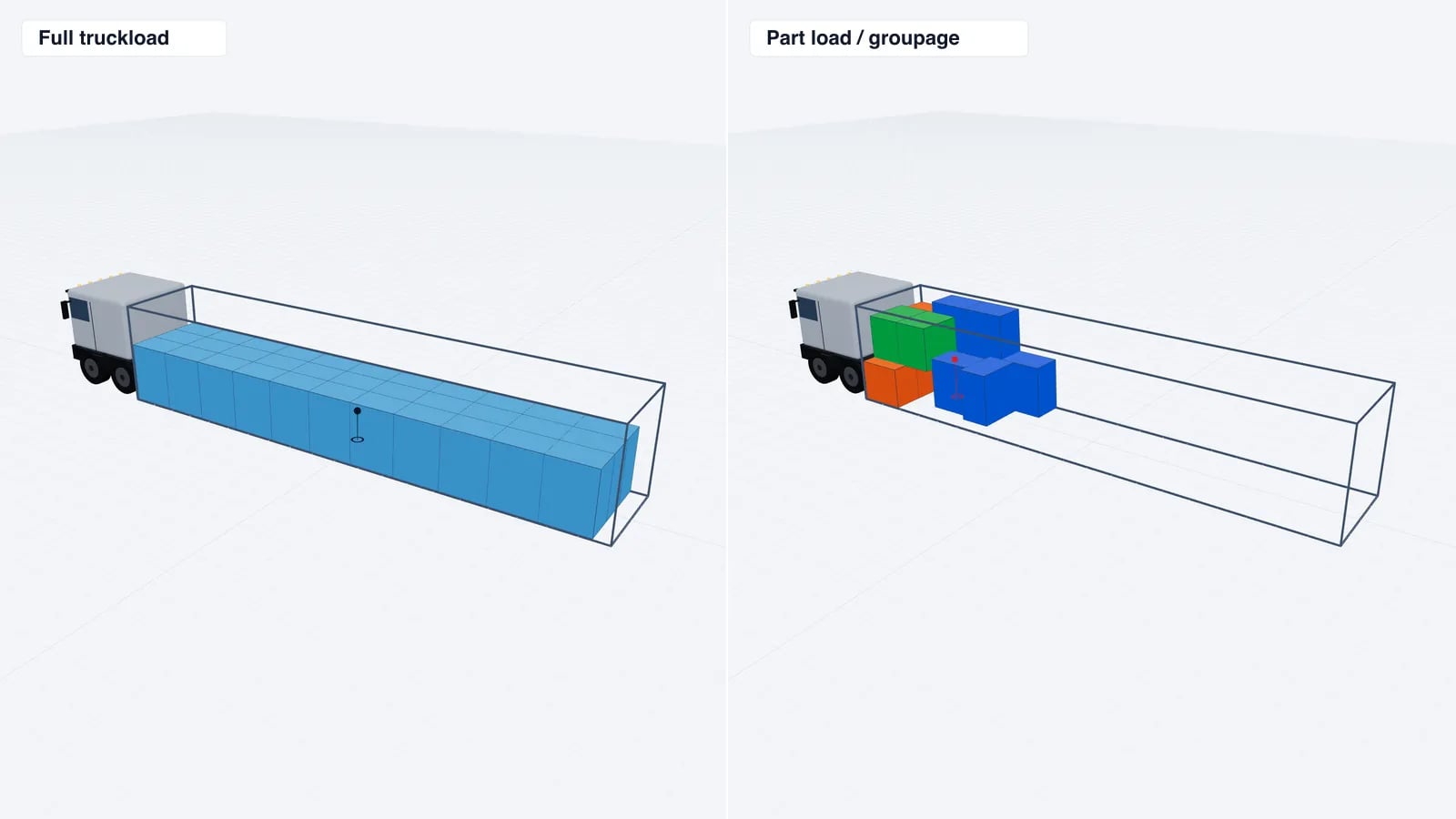
FTL vs LTL: Full Truckload, Part Load or Groupage?
FTL books a whole truck; LTL and groupage share it with other shippers. Compare cost, speed and handling, see how LDM drives LTL price and find your break-even.
Read article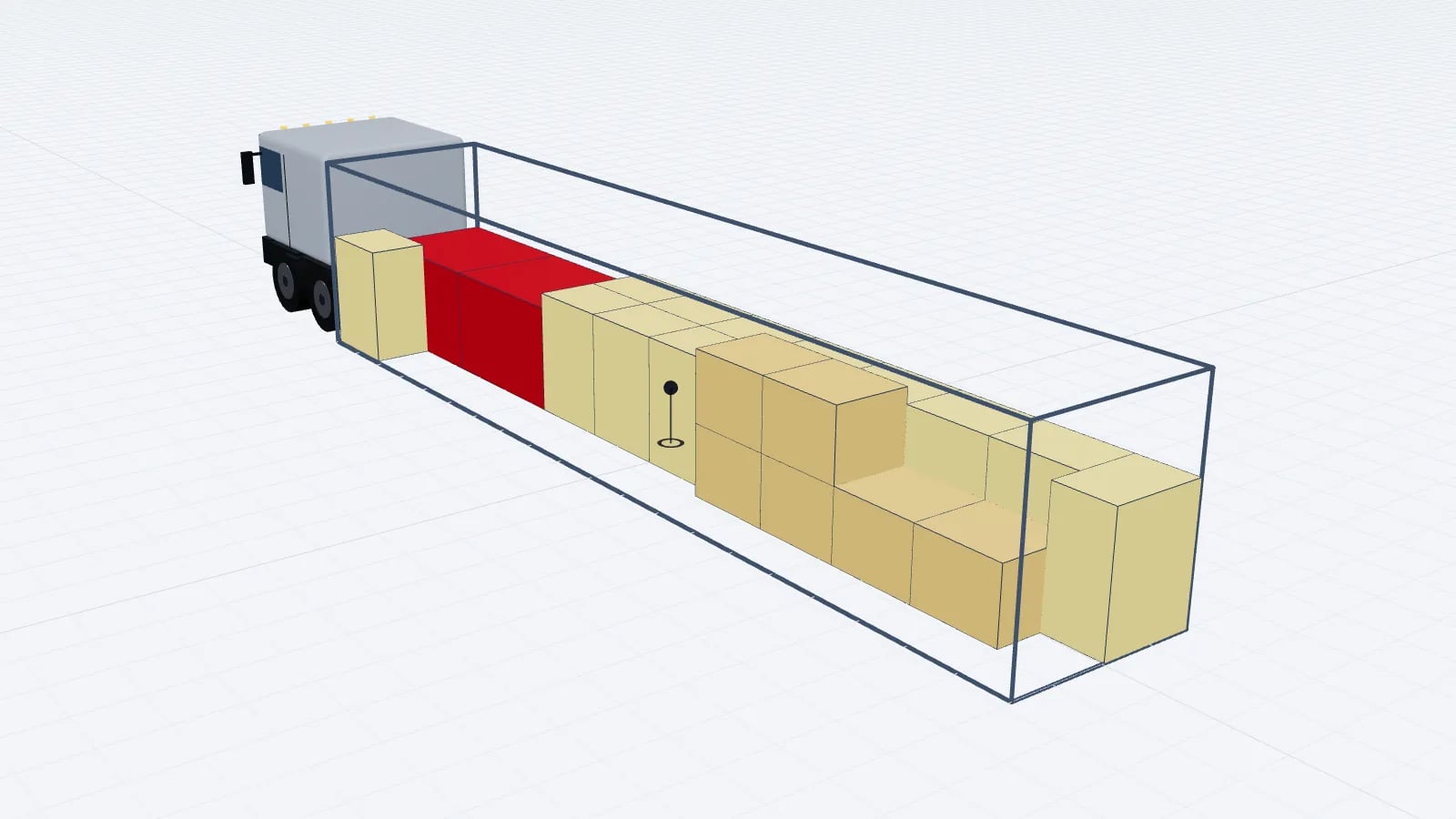
Load planning basics · · 5 min read
Load Centre of Gravity: How to Calculate It for a Truck Load
The centre of gravity of a load is the weighted average of every item's position. Learn the formula, a worked truck example and checks for lateral offset.
Read article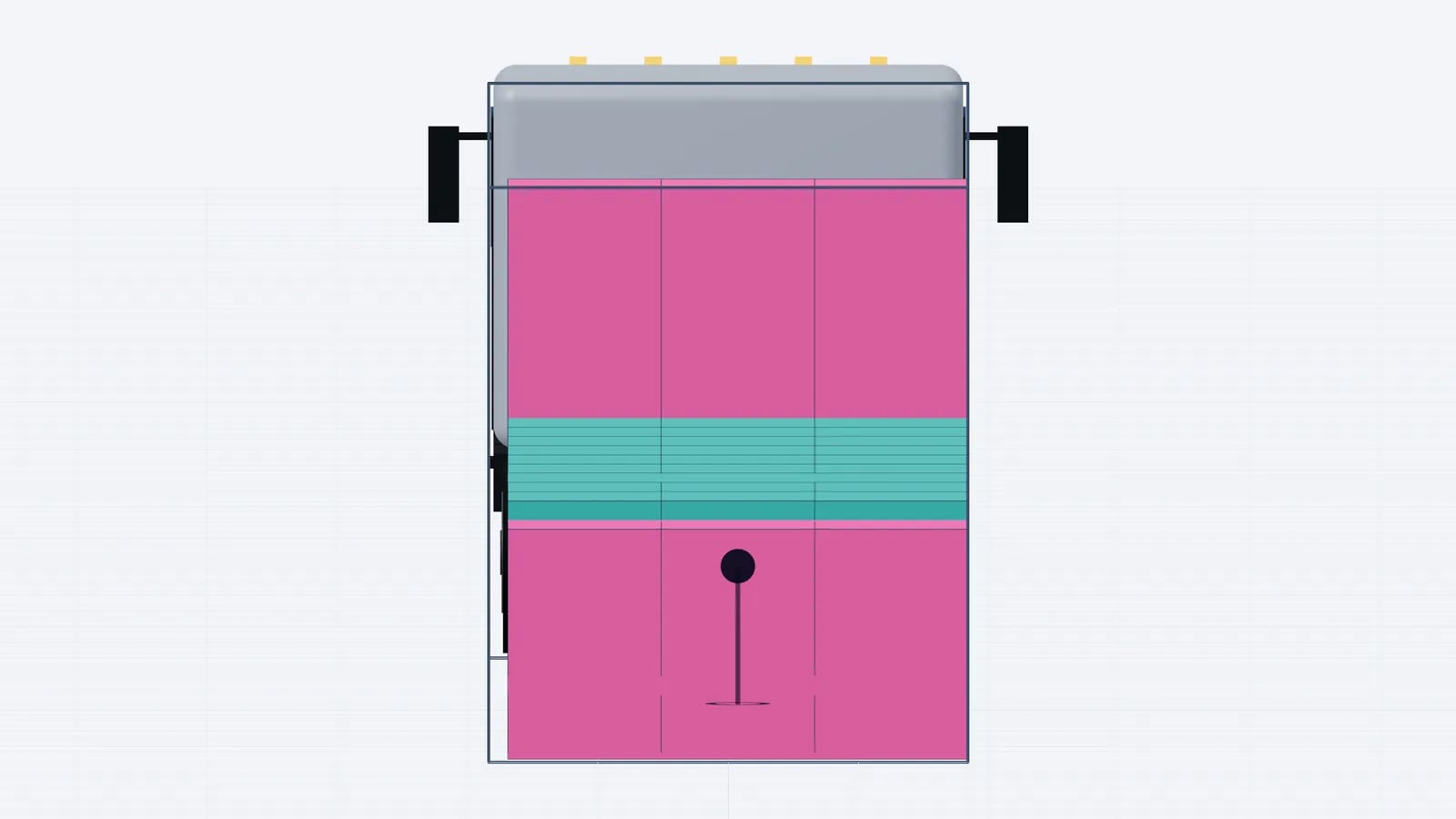
Load planning basics · · 6 min read
Pallet Stacking Rules: Stackability, Weight on Top and Support
Which pallets can be stacked, how much weight can go on top and how much support a top pallet needs. Practical pallet stacking rules for trucks and containers.
Read article