Machinery Transport: Heavy Crates, Point Loads and Balance
Planning machinery transport: heavy crates on a short length, point loads on the trailer floor, centre of gravity, lashing heavy units and when permits apply.
Industry guides · · 6 min read
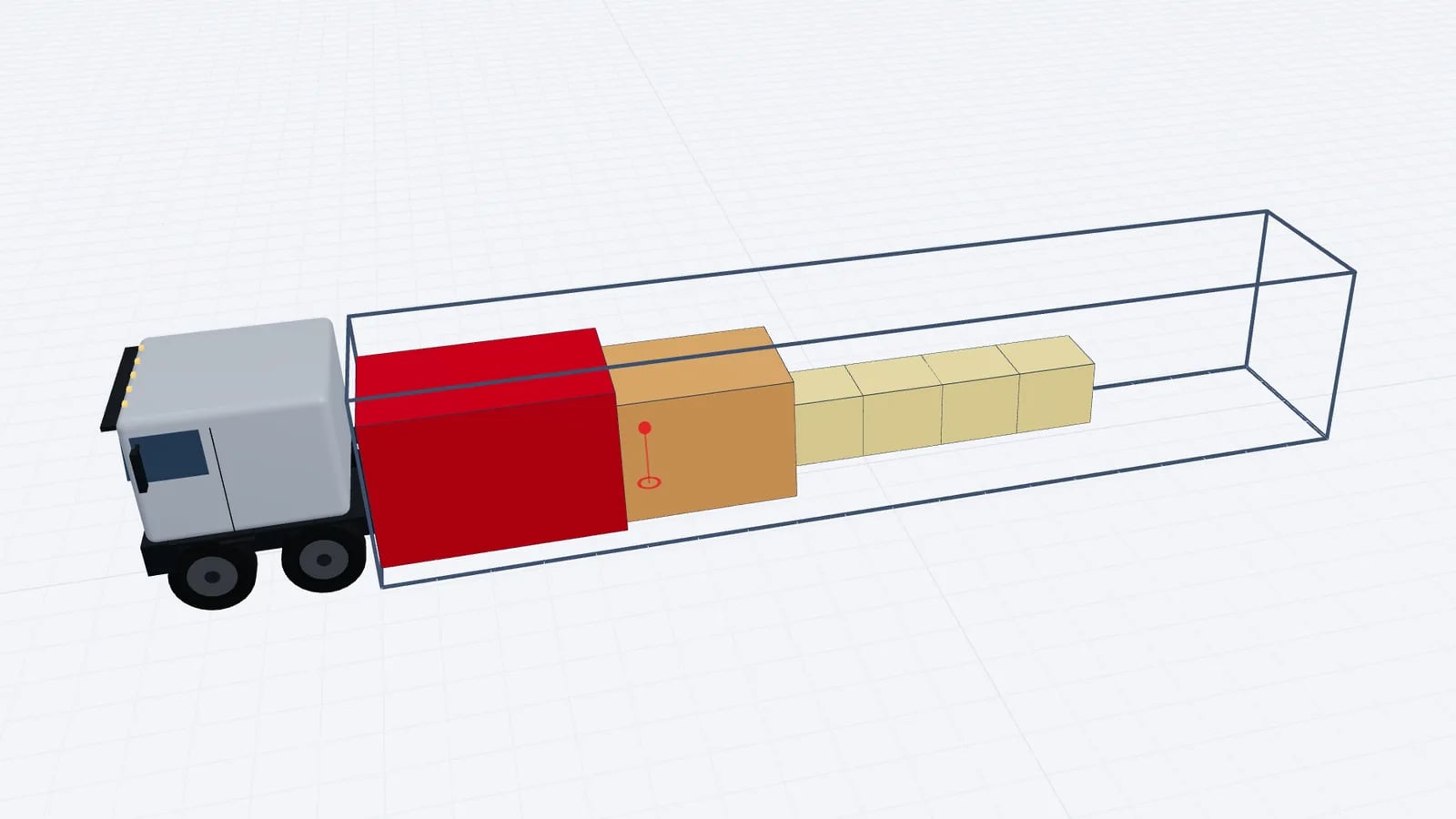
Machinery transport is about concentrated weight. A machine or crate can weigh several tonnes on a footprint of a few square metres, so the plan must check where that weight sits on the trailer, whether the floor can carry it, and how it will be held in place. Volume is rarely the issue; position, balance and securing are.
What makes machinery different
- High weight on a short length. A trailer rated for 24 t payload spread over 13.6 m is not necessarily able to carry 12 t on 2 m of floor.
- Off-centre mass. Machines are rarely symmetrical. The centre of gravity of a crate can be well away from its geometric centre and higher than expected.
- Point loads. Feet, skids and narrow runners concentrate the weight onto small areas of the floor.
- Sensitive parts. Control cabinets, guards and precision surfaces must not take straps or other cargo.
- Sometimes oversize. Wide or tall machines may exceed normal vehicle dimensions and need permits.
Use the trailer load distribution diagram
Most trailer manufacturers publish a load distribution diagram (also called a load distribution plan or chart). It shows the maximum payload the trailer can take for each position of the load's centre of gravity along its length. A typical diagram allows the full payload only when the load's centre of gravity is within a certain zone, usually ahead of the trailer axles, and much less near the headboard or rear doors.
For a single heavy machine, plan its position from that diagram first, then fit the lighter items around it. If you do not have the diagram, ask the carrier or the trailer manufacturer; it is the most useful single document for heavy-item planning.
Worked example: centre of gravity of a machine shipment
Say a shipment consists of one machine on a skid weighing 9,000 kg and two crates of tooling at 2,000 kg each. You plan the machine with its centre of gravity 3.0 m from the headboard and the crates centred at 6.0 m and 8.0 m.
The load's centre of gravity along the trailer is the weighted average: (9,000 × 3.0 + 2,000 × 6.0 + 2,000 × 8.0) / 13,000 = (27,000 + 12,000 + 16,000) / 13,000 = 55,000 / 13,000 = 4.23 m from the headboard.
Whether 4.23 m is acceptable depends on that trailer's diagram. If the diagram allows only 10 t at that position, the plan fails even though 13 t is well inside the payload. Moving the machine back to 4.5 m, and the crates to 7.5 m and 9.5 m to make room, gives (40,500 + 15,000 + 19,000) / 13,000 = 74,500 / 13,000 = 5.73 m. Re-check that diagram for the new position rather than assuming further back is always better.
Also check across the width. A machine whose centre of gravity is 30 cm off the trailer centreline puts noticeably more weight on one side and makes the vehicle less stable in bends. Place it so the combined centre of gravity is as close to the centreline as possible. Load centre of gravity explains the calculation in all three directions.
Tip
Crated machinery should be marked with the centre-of-gravity symbol and lifting points. If it is not, ask the shipper. A crate lifted or placed assuming a central centre of gravity can tip.
Point loads and floor ratings
Trailer floors are typically rated for a forklift axle load, and container floors are rated similarly. A machine standing on four small feet can exceed what the floor boards can take locally, even when the total weight is fine.
- Spread the load with timber bearers or steel beams under the skid so the weight reaches several cross-members.
- Place bearers lengthwise over the main beams where the trailer design allows, to share the load with the chassis.
- Check the floor rating in the trailer specification or with the carrier for very heavy, compact items.
- For containers, heavy concentrated loads may need a load-spreading arrangement; the container owner can advise. See container dunnage and securing.
Securing heavy machinery
EN 12195-1 sets out how to calculate the restraint forces for road transport: in general, the load must be restrained against 0.8 of its weight forwards and 0.5 sideways and backwards. For a 9,000 kg machine that is a lot of force, so friction lashing (tensioning straps over the top) alone is rarely practical.
- Direct lashing with chains or rated webbing from the machine's lashing points to the trailer's lashing points.
- Blocking against the headboard or with chocks and beams fixed to the floor.
- Anti-slip mats under skids to raise friction.
- Lashing capacity of each lashing point on the trailer must be respected; it is stated in the trailer documentation.
This is general guidance, not a securing calculation. For heavy units, get a calculation done or use a securing method the carrier has approved. More background is in load securing basics.
Oversize machines and permits
In most EU countries a road vehicle may be up to 2.55 m wide (2.60 m for refrigerated bodies) and the maximum height is set nationally, often 4 m. A machine that makes the vehicle wider, taller, longer or heavier than the normal limits becomes abnormal or exceptional transport. That usually means:
- a special vehicle such as a low-loader, extendable or modular trailer,
- a permit from each country or region on the route, with set routes and times,
- warning signs, lights and sometimes escort vehicles.
The rules differ by country and the lead time can be weeks, so check with a specialist heavy-haul carrier early. Low-loaders are often used just to keep a tall machine under the height limit.
A planning sequence for machinery
- 1Collect the weight, dimensions, centre of gravity and lifting points of every crate or machine.
- 2Check whether anything is oversize and whether a special vehicle is needed.
- 3Place the heaviest unit using the trailer's load distribution diagram, keeping it on the centreline.
- 4Add lighter items, then recalculate the load's centre of gravity and axle estimate.
- 5Plan load spreading under point loads and the securing method for each heavy unit.
- 6Hand the driver and the loading crew a plan with positions, weights and securing points.
EveryLoading shows the centre of gravity marker and an axle estimate for the cargo as you move a heavy crate; see weight and axle loads. It does not replace the trailer's load distribution diagram or a securing calculation, but it makes it quick to try positions before anything is lifted.
Frequently asked questions
Can a trailer carry its full payload on a short length?
Not usually. The load distribution diagram for most trailers allows full payload only when the load is spread or centred in a specific zone; a heavy machine on 2 m of floor may be limited to much less.
How do you find the centre of gravity of a machinery load?
Multiply each item weight by the position of its own centre of gravity, add them up and divide by the total weight. Do it along the length and across the width.
When does machinery transport need a permit?
When the vehicle with the load exceeds the normal width, height, length or weight limits of the countries on the route. Rules and lead times vary, so check with the authorities or a heavy-haul carrier.
What is the best way to secure a heavy machine?
Direct lashing with chains or rated straps to its lashing points, combined with blocking and anti-slip mats. Friction lashing alone is rarely enough for multi-tonne units.
Keep reading
Industry guides · · 5 min read
Fresh Produce Transport: Planning Crates, Bins and Reefers
Fresh produce transport planning: crates and bins, temperature and ventilation in general terms, product compatibility, airflow and when produce weighs out.
Read article
Industry guides · · 6 min read
Beverage Pallet Loading: Plan for Weight Before Volume
Beverage pallets run out of payload long before the trailer is full. How to work out the pallet count, spread the weight over the axles and decide on stacking.
Read article
Industry guides · · 5 min read
Removal Truck Loading: Survey, Size and Load a Household Move
Removal truck loading for movers: turning a volume survey into the right vehicle, loading order for furniture and boxes, protection, and shared-load moves.
Read article