Building Materials Transport: Planning Long, Heavy Site Loads
How to plan building materials transport: long profiles and timber, heavy bagged and block pallets, flatbed or curtainsider, unloading on site and securing.
Industry guides · · 6 min read
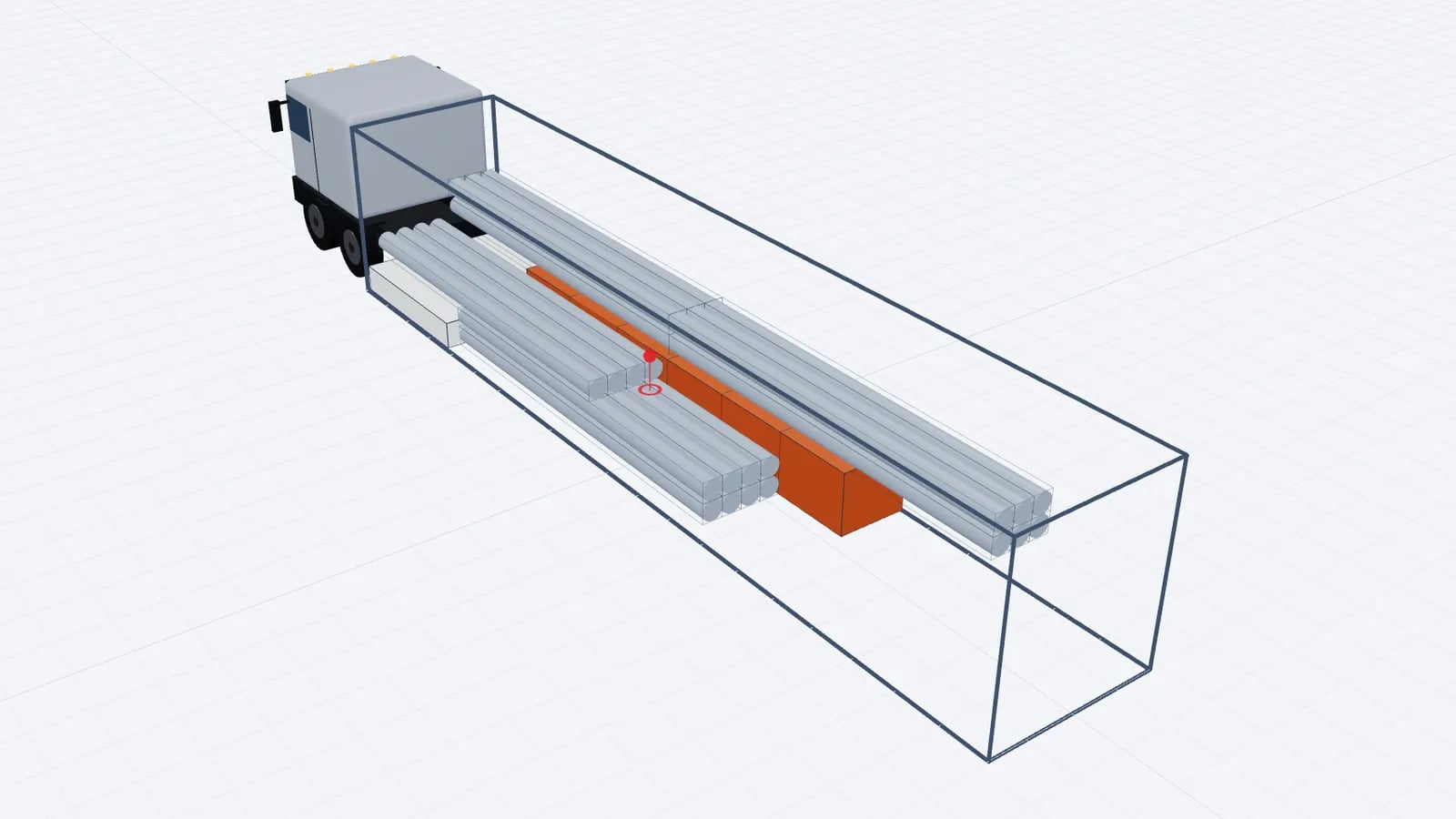
Building materials transport mixes two awkward kinds of cargo: long items such as steel profiles, timber and pipes, and dense pallets of blocks, bagged cement or tiles. Plan the long items first because they fix the layout, check the heavy pallets against payload and axle loads, and choose the vehicle by how the site will unload it, not only by what fits.
Know what you are carrying
Builders' merchants and manufacturers ship a wide spread of densities. The planning problem changes with each group.
Material: Blocks, bricks, pavers
- Typical form
- Industrial pallets (1200 × 1000 mm), often 1–1.5 t each
- Planning issue
- Weight; floor and axle loads; usually not stacked
Material: Cement, plaster, mortar
- Typical form
- 25 kg bags on pallets, e.g. 48 bags ≈ 1.2 t
- Planning issue
- Weight; bags slump and need wrapping
Material: Plasterboard, panels
- Typical form
- Packs of boards, commonly 2.4–3.0 m long
- Planning issue
- Long and heavy; board edges damage easily
Material: Timber
- Typical form
- Bundles in standard lengths, often 3–6 m
- Planning issue
- Length; bundles can splay if strapping fails
Material: Steel profiles, rebar, pipes
- Typical form
- Bundles 6 m or 12 m long
- Planning issue
- Length, high density, sharp edges, very low friction
Material: Insulation
- Typical form
- Large compressed packs
- Planning issue
- Very light and bulky; volume limited
| Material | Typical form | Planning issue |
|---|---|---|
| Blocks, bricks, pavers | Industrial pallets (1200 × 1000 mm), often 1–1.5 t each | Weight; floor and axle loads; usually not stacked |
| Cement, plaster, mortar | 25 kg bags on pallets, e.g. 48 bags ≈ 1.2 t | Weight; bags slump and need wrapping |
| Plasterboard, panels | Packs of boards, commonly 2.4–3.0 m long | Long and heavy; board edges damage easily |
| Timber | Bundles in standard lengths, often 3–6 m | Length; bundles can splay if strapping fails |
| Steel profiles, rebar, pipes | Bundles 6 m or 12 m long | Length, high density, sharp edges, very low friction |
| Insulation | Large compressed packs | Very light and bulky; volume limited |
Pallet weights depend on the product and manufacturer, so take them from the delivery note or the warehouse system. A block pallet that is 1,350 kg from one supplier can be 1,600 kg from another.
Flatbed, curtainsider or crane truck?
The right vehicle depends on how the goods will be unloaded at the site as much as on size.
- Curtainsider: loads and unloads from the side with a forklift, protects plasterboard, cement and insulation from rain. The most common choice for palletised materials.
- Flatbed or platform trailer: suits steel, long timber and anything lifted by crane from above. Goods are exposed, so moisture-sensitive products need covering.
- Truck with loader crane: delivers to sites without a forklift. The crane's reach and capacity at reach limit where heavy pallets can sit on the bed, so plan heavy items closest to the crane.
- Extendable trailers: for profiles or beams longer than a standard 13.6 m bed. These are usually special transport and may need permits; check national rules.
Curtainsiders also matter for securing: the curtain is generally not a load-restraint device unless the body is certified for it, so the load still needs strapping or blocking. See load securing basics.
Worked example: a mixed merchant delivery
Say a builders' merchant needs to send one semitrailer (13.6 × 2.45 m floor, 24,000 kg payload) to a site with:
- 10 industrial pallets of concrete blocks, 1200 × 1000 mm, 1,350 kg each = 13,500 kg
- 6 Euro pallets of cement, 48 bags of 25 kg plus the pallet, about 1,225 kg each = 7,350 kg
- 4 bundles of timber, 4.8 m × 0.6 m × 0.5 m, 600 kg each = 2,400 kg
Total weight is 13,500 + 7,350 + 2,400 = 23,250 kg, inside the payload with 750 kg to spare.
Floor space works out like this. The block pallets go two abreast with the 1.2 m side across the trailer (2.4 m), so each row uses 1.0 m of length: 5 rows, 5.0 m. The cement pallets go three abreast with the 0.8 m side across (2.4 m): 2 rows of 1.2 m, 2.4 m. The four timber bundles lie side by side (4 × 0.6 m = 2.4 m) and take 4.8 m. That is 5.0 + 2.4 + 4.8 = 12.2 m of the 13.6 m floor.
Where each group goes is a weight question. Putting all 13.5 t of blocks against the headboard and the light timber at the doors moves the load's centre of gravity forward. Here it is better to place the cement at the front, the blocks in the middle over the trailer's centre, and the timber at the rear, then check the axle estimate. If the site unloads by crane, also consider which items the crane can reach at its rated capacity.
Good to know
The example uses round numbers. Real trailers vary in internal width and payload, and some curtainsiders have stanchions or straps that reduce the usable width by a few centimetres, which can stop pallets going three or two abreast.
Planning long items
Long items decide the layout because they cannot be rotated across a 2.45 m wide trailer. Plan them first, then fill around them.
- Lay long bundles along the trailer, side by side, and keep them full length on the floor where possible. Overhanging bundles bend and spring.
- Use bearers (timber battens) under bundles so forks or crane slings can get underneath at the site.
- Do not stack heavy pallets on top of long bundles unless the bundle is rigid and the load spreads over enough bearers.
- Respect overhang rules. Rear overhang beyond the vehicle is limited and must be marked; limits vary by country.
For profiles that are shorter than the trailer but longer than half of it, plan a lane: a 6 m bundle in a 13.6 m trailer leaves 7.6 m, enough for six rows of Euro pallets three abreast (7.2 m) in the remaining length.
Securing heavy and slippery materials
Steel on a steel or wooden bed has low friction, and bagged goods can shift as the bags settle. EN 12195-1 sets out how to calculate the restraint needed; the practical points are:
- Use anti-slip mats under steel bundles and heavy pallets; they raise friction and reduce the number of lashings needed.
- Block against the headboard or with chocks wherever possible. Blocking is more efficient than friction lashing for dense goods.
- Put edge protectors under straps on board packs and bagged pallets.
- Leave no gaps in the middle of the load. If a gap is unavoidable, fill or block it; dunnage and void fill covers the options.
Tip
Building materials are often delivered to several sites on one run. Load the last site's goods first and deepest, and check the axle loads after each drop, especially if heavy block pallets come off at the rear early. Multi-drop load planning explains the loading order.
Doing it in a planner
In EveryLoading you can enter long bundles with rotation limited so they stay lengthwise, mark block pallets as non-stackable, and let the optimizer fill the rest; see cargo settings. Delivery stops are set per row in the cargo list, and the PDF load plan gives the yard team the top and side drawings to load from.
Frequently asked questions
What trailer is best for building materials?
A curtainsider suits palletised, weather-sensitive goods unloaded by forklift. A flatbed or crane truck suits steel, long timber and sites without a forklift.
How do you transport 6 m or 12 m steel profiles?
Lay them lengthwise on bearers along the trailer, on anti-slip mats, and block or lash them; 12 m bundles take most of a 13.6 m bed, and longer items usually need an extendable trailer and possibly a permit.
Can block pallets be double-stacked?
Usually not. They are heavy enough that the trailer weighs out before space runs out, and stacking raises the centre of gravity and the risk of collapse.
Where should heavy pallets go on a mixed building materials load?
Generally over the middle of the trailer rather than all at the headboard, so the tractor drive axle and the trailer axles share the weight. Check the axle estimate for the final layout.
Keep reading
Industry guides · · 5 min read
Fresh Produce Transport: Planning Crates, Bins and Reefers
Fresh produce transport planning: crates and bins, temperature and ventilation in general terms, product compatibility, airflow and when produce weighs out.
Read article
Industry guides · · 6 min read
Beverage Pallet Loading: Plan for Weight Before Volume
Beverage pallets run out of payload long before the trailer is full. How to work out the pallet count, spread the weight over the axles and decide on stacking.
Read article
Industry guides · · 5 min read
Removal Truck Loading: Survey, Size and Load a Household Move
Removal truck loading for movers: turning a volume survey into the right vehicle, loading order for furniture and boxes, protection, and shared-load moves.
Read article