E-commerce Freight Consolidation: Cartons, Cages and Trailers
How e-commerce freight consolidation works in practice: mixed carton sizes, roll cages and pallets, filling line-haul trailers and planning multi-drop runs.
Industry guides · · 5 min read
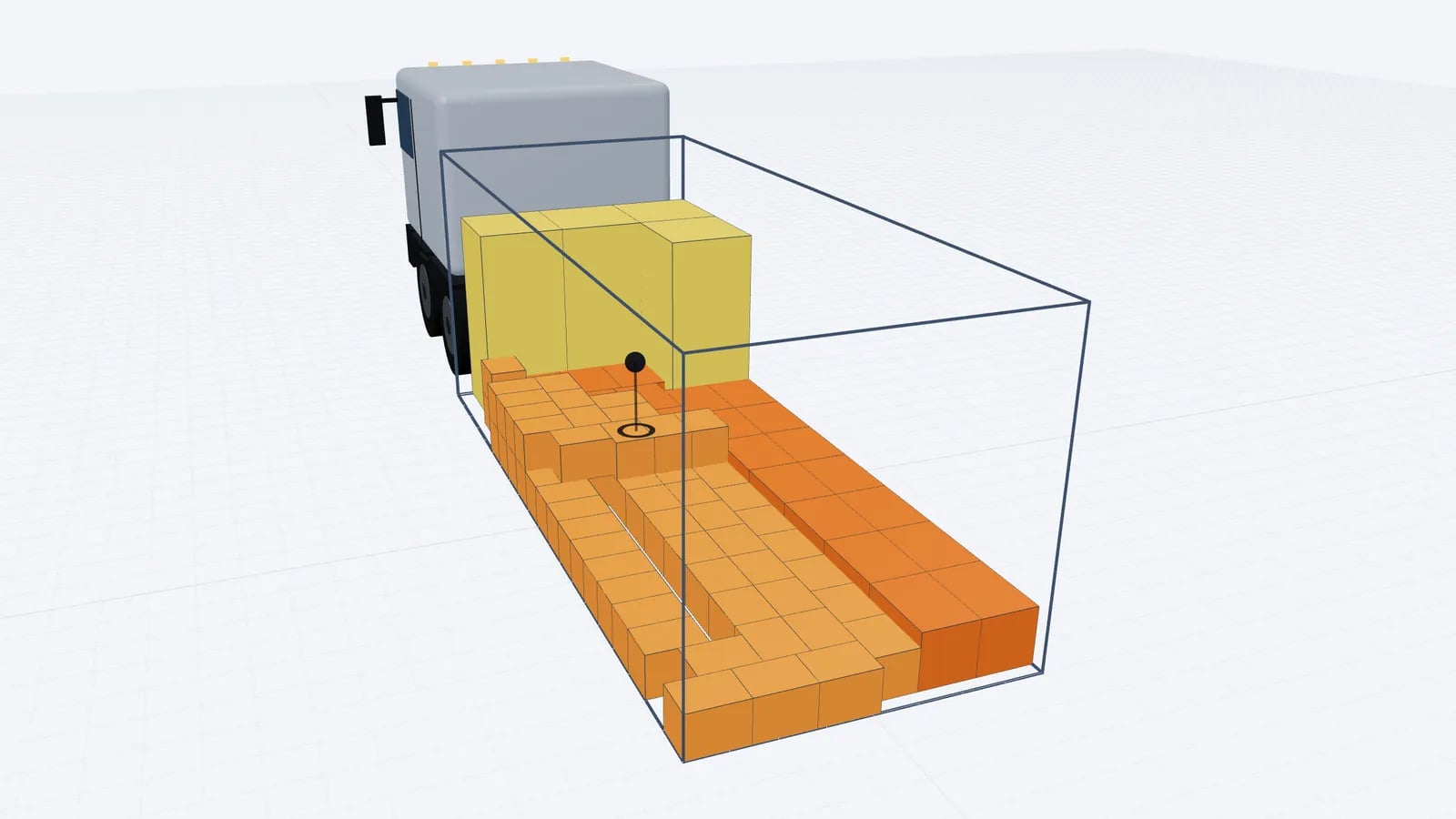
E-commerce freight consolidation means combining many small shipments, usually cartons of all sizes, into larger units such as roll cages, pallets or gaylords, and those units into full line-haul trailers or containers. The planning goal is to ship as little air as possible, keep each destination's freight together, and make the trailer quick to unload at the hub or depot.
The three levels of consolidation
Level: Carton
- Unit
- Shipping box per order
- Main planning question
- Is the box the right size for the item, or are we shipping air?
Level: Handling unit
- Unit
- Roll cage, pallet, bulk bin or gaylord
- Main planning question
- How tightly are cartons built into the unit, and is it sorted by destination?
Level: Vehicle
- Unit
- Line-haul trailer, swap body, container
- Main planning question
- How many units fit, in what order, and does weight or volume run out first?
| Level | Unit | Main planning question |
|---|---|---|
| Carton | Shipping box per order | Is the box the right size for the item, or are we shipping air? |
| Handling unit | Roll cage, pallet, bulk bin or gaylord | How tightly are cartons built into the unit, and is it sorted by destination? |
| Vehicle | Line-haul trailer, swap body, container | How many units fit, in what order, and does weight or volume run out first? |
Gains at the carton level carry through to everything above it. A well-chosen range of box sizes reduces void fill and the number of cages per trailer. Carriers also charge on dimensional weight: many parcel and express carriers use a divisor of 5,000 cm³/kg for road and express, and air freight uses the IATA divisor of 6,000 cm³/kg, but the divisor is set by each contract. Air cargo chargeable weight shows the arithmetic.
Building good handling units
- Heaviest and strongest cartons at the bottom, light and fragile ones on top.
- Build in layers of similar height where you can. A flat top lets another unit or a cage shelf sit on it.
- Sort by destination before building. A cage that mixes two depots has to be re-sorted, which defeats consolidation.
- Wrap or strap pallets of loose cartons; for cages, close the gates and use the straps or bars fitted.
- Record the real height and weight of each unit as it is closed. Planning with a standard height for every pallet wastes space or overloads the truck.
Worked example: roll cages in a trailer
Roll cage sizes vary by network. Say yours have a footprint of 800 × 720 mm and are 1.8 m tall, and you load them into a trailer with a 13.6 × 2.45 m floor.
With the 720 mm side across the trailer, three cages take 2.16 m of width and each row takes 0.8 m of length: 13.6 / 0.8 = 17 rows exactly. Zero clearance is not realistic, so plan 16 rows, 48 cages. Turned the other way, three cages with the 800 mm side across take 2.40 m of width (5 cm spare in total) and each row takes 0.72 m: 18 rows use 12.96 m, giving 54 cages.
That is six more cages from the same trailer just by turning them, provided the drivers can actually manoeuvre cages with that little side clearance. If they cannot, 48 is the honest number. Cages are not stackable, so the 0.9 m above them in a 2.7 m trailer stays empty unless the trailer has a second deck.
Weight is rarely a limit: at, say, 250 kg per loaded cage, 54 cages weigh 13,500 kg, well under a typical 24 t payload. That points to other ways of using the trailer better: double-deck trailers, mixing pallets of heavy parcels on the floor with cages, or taller units on a mega trailer.
Mixed units on one trailer
Many line-haul trailers carry a mix: cages of small parcels, pallets of large parcels and some loose bulky items that do not fit either. Plan in this order:
- 1Group units by destination hub or depot.
- 2Place the units that have the fewest options first: oversize items and non-stackable pallets.
- 3Fill lanes with cages, oriented for the best count your dock team can handle.
- 4Use stackable pallets of strong cartons to use height where the trailer allows.
- 5Check total weight and, for heavy parcel pallets, the axle estimate.
- 6Load in reverse drop order if the trailer serves more than one depot.
Multi-drop line-haul
A trailer that calls at two or three depots must be unloaded in order without moving other depots' freight. The last depot's units go in first, at the front, and the first depot's units go at the doors. Keep each depot's units in a solid block across the full width rather than spread along one side, so the unloader clears whole rows. Multi-drop load planning covers the method in detail.
Peak periods change the picture. When volumes jump, a lane that normally runs one trailer may need two, and it is tempting to split the freight by whatever is ready first. Splitting by destination instead, one trailer per depot or group of depots, keeps unloading simple at the other end, even if one trailer leaves fuller than the other. Decide the split rule before the peak, so the dock is not improvising at night.
Tip
If one depot's volume changes a lot from day to day, put it at the doors. It is easier to adjust the last block loaded than one buried in the middle.
Measuring how well you consolidate
Useful measures are simple ratios you can track per lane:
- Units per trailer against the planned maximum for that unit mix.
- Volume fill: total volume of units divided by usable trailer volume.
- Cartons per cage or pallet, which shows whether units are being built tightly.
- Cost per parcel or per kg on each line-haul lane.
Truck fill rate KPIs gives the formulas, and reducing empty space in trucks covers the main fixes.
For daily planning, a 3D planner saves the dock team from guessing. In EveryLoading you can paste the unit list from the warehouse system, set each depot as a delivery stop, and let the optimizer place later stops deeper; see delivery stops and using several trucks for days when one trailer is not enough.
Frequently asked questions
What is freight consolidation in e-commerce?
Combining many individual parcels or cartons into larger handling units, such as cages or pallets, and those into full trailers or containers, so fewer vehicles carry the same volume.
How many roll cages fit in a trailer?
It depends on the cage footprint and orientation. In the example, 800 × 720 mm cages fit 48 with the narrow side across a 13.6 m trailer and 54 when turned, if the dock team can handle the tight side clearance.
Is e-commerce freight limited by weight or volume?
Usually volume. Parcels are light for their size, so trailers fill up long before they reach payload, which is why carton sizing and unit building matter.
How should a line-haul trailer serving several depots be loaded?
In reverse order of the stops, with each depot in a solid block across the full width so it can be unloaded without moving freight for other depots.
Keep reading
Industry guides · · 5 min read
Fresh Produce Transport: Planning Crates, Bins and Reefers
Fresh produce transport planning: crates and bins, temperature and ventilation in general terms, product compatibility, airflow and when produce weighs out.
Read article
Industry guides · · 6 min read
Beverage Pallet Loading: Plan for Weight Before Volume
Beverage pallets run out of payload long before the trailer is full. How to work out the pallet count, spread the weight over the axles and decide on stacking.
Read article
Industry guides · · 5 min read
Removal Truck Loading: Survey, Size and Load a Household Move
Removal truck loading for movers: turning a volume survey into the right vehicle, loading order for furniture and boxes, protection, and shared-load moves.
Read article