FMCG Distribution: Load Planning for Multi-Drop Retail Runs
Load planning for FMCG distribution: mixed pallets of uneven height, multi-drop store deliveries, delivery windows, axle loads that change as drops come off.
Industry guides · · 5 min read
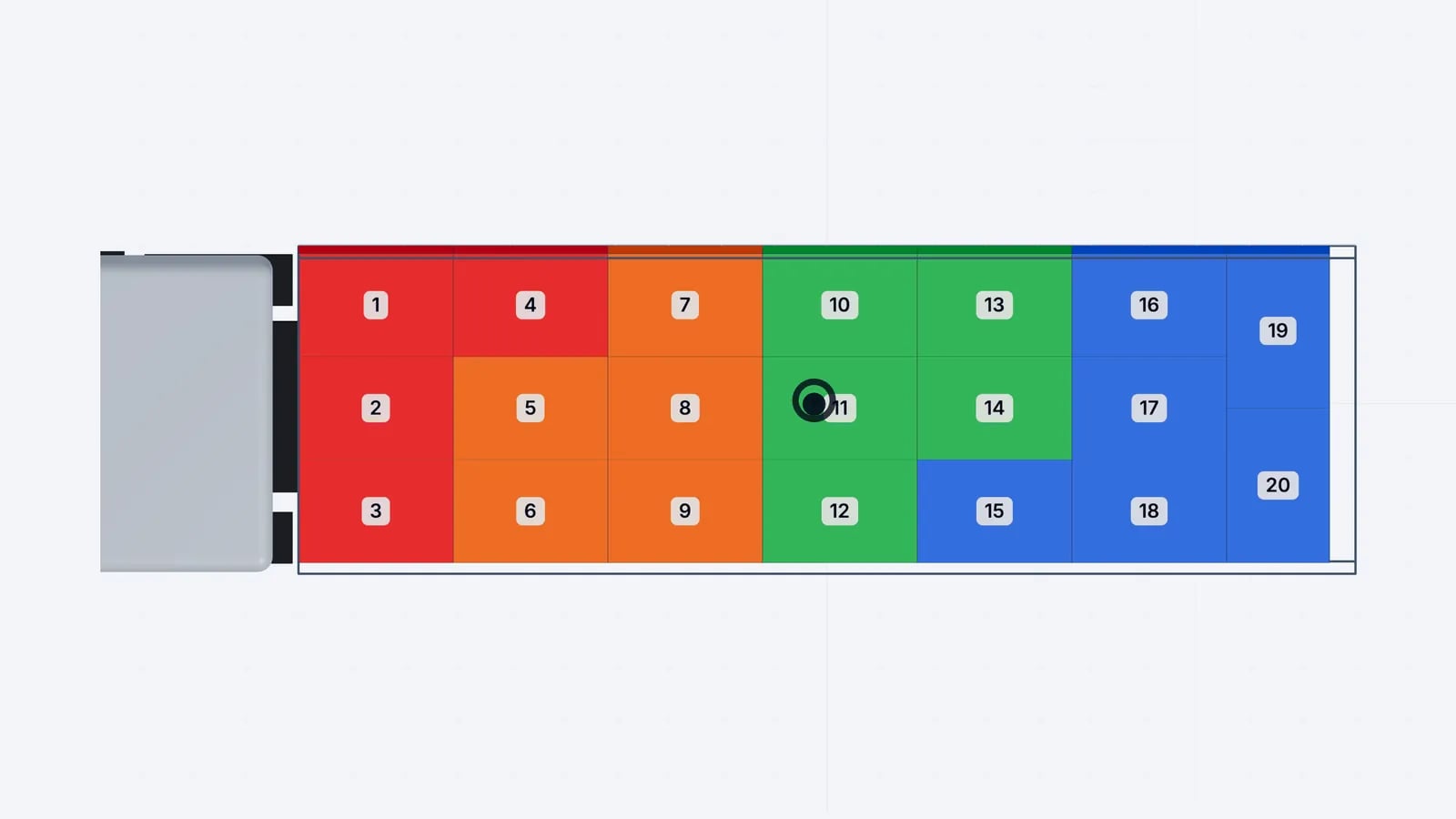
FMCG distribution loads are built from mixed pallets of uneven height and weight, going to several stores or customers on one run, each with a delivery window. A good plan follows the route: the last drop is loaded first, each drop is a block the driver can unload without moving others, and the axle loads are checked not only at departure but after every drop.
What makes FMCG loads hard to plan
- Mixed pallets. Picked pallets contain many SKUs, so height and weight vary from pallet to pallet. Standard heights on paper rarely match the dock.
- Many drops. A store run may have anything from two to a dozen stops, each with its own unloading point and equipment.
- Delivery windows. The route order is fixed by the customer slots, so the plan cannot reorder stops to suit the load.
- Several temperature regimes. Ambient, chilled and frozen often share a multi-temperature vehicle with bulkheads.
- Returns. Empty cages, pallets, trays and packaging come back on the same vehicle and need space after each drop.
From delivery windows to load order
In FMCG the route drives the load, not the other way round. Plan in this order:
- 1Fix the route and stop order from the delivery windows and travel times.
- 2Collect the actual pallet list per stop, with measured height and weight from the pick or wrap station.
- 3Assign each stop a block of the vehicle: the last stop at the front, the first stop at the doors.
- 4Within each block, put heavy pallets on the floor; stack only low, strong pallets where the customer accepts double-stacked deliveries.
- 5Check the gross weight and the axle estimate at departure and after each drop.
- 6Plan where returns go once each block is emptied.
The general method for reverse loading order is in multi-drop load planning; the rest of this article focuses on the FMCG-specific issues.
Worked example: a four-drop store run
Say a semitrailer with 33 Euro pallet positions and 24,000 kg payload serves four stores:
Stop: 1 (first)
- Pallets
- 8
- Avg weight
- 600 kg
- Stop weight
- 4,800 kg
- Rows of 3
- 2 rows + 2 pallets
Stop: 2
- Pallets
- 6
- Avg weight
- 500 kg
- Stop weight
- 3,000 kg
- Rows of 3
- 2 rows
Stop: 3
- Pallets
- 7
- Avg weight
- 550 kg
- Stop weight
- 3,850 kg
- Rows of 3
- 2 rows + 1 pallet
Stop: 4 (last)
- Pallets
- 9
- Avg weight
- 650 kg
- Stop weight
- 5,850 kg
- Rows of 3
- 3 rows
Stop: Total
- Pallets
- 30
- Avg weight
- Stop weight
- 17,500 kg
- Rows of 3
| Stop | Pallets | Avg weight | Stop weight | Rows of 3 |
|---|---|---|---|---|
| 1 (first) | 8 | 600 kg | 4,800 kg | 2 rows + 2 pallets |
| 2 | 6 | 500 kg | 3,000 kg | 2 rows |
| 3 | 7 | 550 kg | 3,850 kg | 2 rows + 1 pallet |
| 4 (last) | 9 | 650 kg | 5,850 kg | 3 rows |
| Total | 30 | 17,500 kg |
Stop 4 goes in first, at the headboard, in three full rows. Stop 3's seven pallets follow, then stop 2's six, then stop 1's eight at the doors. Thirty pallets use 30 of 33 positions, and the load weighs 17,500 kg, well inside payload.
Where a stop does not fill a whole row, as with stops 1 and 3, decide whether the odd pallets sit centred or at one side. Keeping the incomplete row at the door side of the stop's block means the driver reaches it first and the next stop's full rows stay intact.
The diminishing load problem
Gross weight falls with every drop, so it is easy to assume the vehicle only gets safer. On many vehicles it does not. On a rigid truck in particular, when the rear pallets come off first, the remaining weight sits further forward, and the front axle can end up over its limit even though the vehicle is much lighter overall. On an articulated vehicle, removing weight changes the share between the tractor and trailer axles, and the result depends on where the trailer axles are relative to the remaining load.
In the example, after stops 1 and 2 are delivered, 9,700 kg remains in the front 7.2 m of the trailer (six rows, the last only partly filled): stops 3 and 4 together. Check the axle estimate for that remaining load, not only for the departure load. If the front axle is near its limit, options include moving heavier stops further back in the plan (which may mean a different block layout), using a vehicle with a higher front axle rating, or splitting the route.
Tip
Run the axle estimate for each stage of the route: full, after drop 1, after drop 2 and so on. The worst case is often in the middle of the route, not at departure.
Mixed pallet heights and double-stacking
Some retail customers accept double-stacked pallets; many do not, because their store staff cannot de-stack without a forklift. Where it is allowed:
- Stack only within the same stop, never one stop's pallet on top of another's.
- Put the lower, heavier, flat-topped pallet underneath.
- Check that the combined height is below the internal height with clearance for the forks.
- Do not stack on pallets of crushable products such as crisps or eggs.
General rules are in pallet stacking rules and double stacking pallets in trailers.
Multi-temperature and returns
A multi-temperature trailer splits the floor into compartments, each with its own drops. The stop order still applies within each compartment, but side doors let a driver reach the rear compartment without opening the front one. Plan the bulkhead position from the volume in each regime on that day, not a fixed split.
Returns need space too. Once a stop is unloaded, its block becomes the space for that store's returns. If a store returns more than it received, plan for it, or the driver will have to refuse returns at a later stop.
EveryLoading takes a stop number on each cargo row and loads later stops deeper; the loading sequence view lets the dock check the order, and the PDF gives the driver the drop-by-drop picture. Its axle figures are estimates for the cargo only, so verify borderline loads on a weighbridge.
Frequently asked questions
How do you plan the load for a multi-drop FMCG route?
Fix the stop order from the delivery windows, then load the last stop first at the front and the first stop last at the doors, keeping each stop in its own block.
What is the diminishing load effect?
As deliveries come off, the remaining weight can shift the axle loads so one axle, often the front axle of a rigid truck, becomes overloaded even though the vehicle is lighter overall.
Can mixed retail pallets be double-stacked?
Only if the customer accepts double-stacked deliveries, the lower pallet is strong and flat-topped, and both pallets belong to the same stop.
How should returns be planned on a store run?
Use each emptied block for that store's returns, and plan extra space where a store regularly returns more than it receives.
Keep reading
Industry guides · · 5 min read
Fresh Produce Transport: Planning Crates, Bins and Reefers
Fresh produce transport planning: crates and bins, temperature and ventilation in general terms, product compatibility, airflow and when produce weighs out.
Read article
Industry guides · · 6 min read
Beverage Pallet Loading: Plan for Weight Before Volume
Beverage pallets run out of payload long before the trailer is full. How to work out the pallet count, spread the weight over the axles and decide on stacking.
Read article
Industry guides · · 5 min read
Removal Truck Loading: Survey, Size and Load a Household Move
Removal truck loading for movers: turning a volume survey into the right vehicle, loading order for furniture and boxes, protection, and shared-load moves.
Read article