Furniture Transport Planning: Bulky, Light and Easily Damaged
Furniture fills a trailer long before it reaches payload. How to plan bulky, fragile, non-stackable items, choose orientations and protect surfaces in transit.
Industry guides · · 5 min read
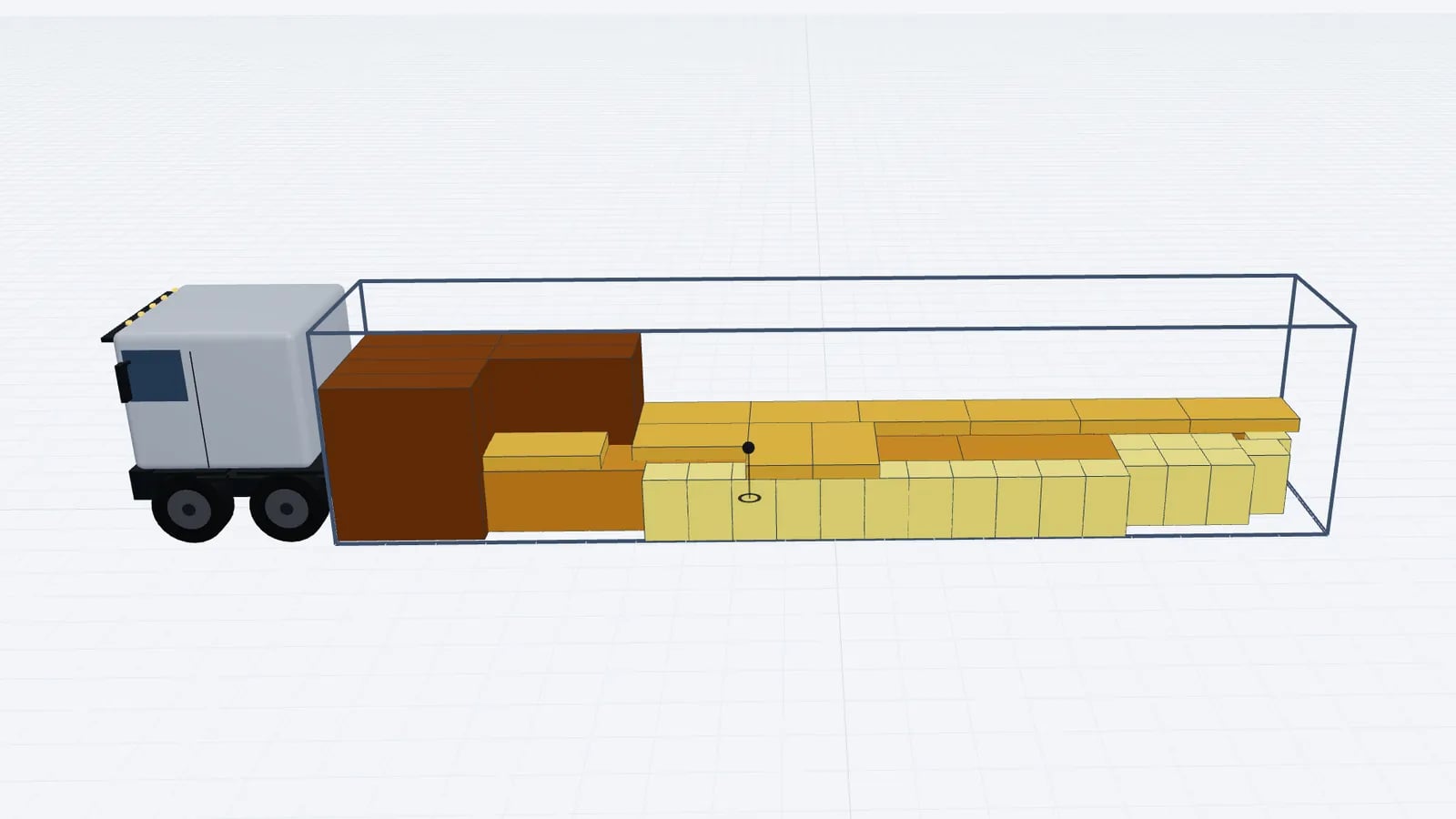
Furniture transport is a volume problem. Sofas, wardrobes, tables and flat-pack cartons are light for their size, so the trailer fills up long before it reaches payload. Planning comes down to choosing the orientation each item is allowed in, deciding what may be stacked, and protecting surfaces that mark or crack.
Why furniture cubes out
A standard semitrailer has roughly 90 m³ of internal volume (13.6 × 2.45 × 2.7 m) and a payload in the region of 24 t. That is about 267 kg per cubic metre if you want both limits to run out at the same time. Most furniture is far lighter than that: a packed sofa might be 35–50 kg/m³ and flat-pack cartons often a few hundred kilograms per cubic metre at most.
So weight is rarely the constraint. The questions that matter are how much floor and height each item really needs, and how much of the air above and around it can be used. That also explains why part loads of furniture are usually priced by loading metres or volume, not weight; see FTL vs LTL and loading metres explained.
Orientation matters more than stacking
Furniture rules usually say what may not be done: this side up, do not stand on end, do not stack. Get these rules from the manufacturer's packaging spec and enter them per item. Within those rules, turning an item 90 degrees on the floor can change the count more than stacking does.
Worked example: 40 packed sofas
Say you have 40 packed three-seater sofas, each 2.10 × 0.95 × 0.85 m (length × depth × height) and 60 kg, for a trailer with a 13.6 × 2.45 m floor and 2.7 m internal height. Total weight is 2,400 kg, so payload is irrelevant. Total volume is 40 × 1.696 = about 67.8 m³, which looks like it fits in 90 m³, but the shape decides.
Allowed orientation: Flat, long side along the trailer
- Floor layout
- 2 across (1.90 m), 6 rows of 2.10 m
- Per tier
- 12
- Tiers possible
- 1 (no stacking)
- Sofas that fit
- 12
Allowed orientation: Flat, turned crosswise
- Floor layout
- 1 across (2.10 m), 14 rows of 0.95 m
- Per tier
- 14
- Tiers possible
- 1 (no stacking)
- Sofas that fit
- 14
Allowed orientation: Flat, crosswise, stacked 3 high
- Floor layout
- 14 per tier, 3 × 0.85 = 2.55 m
- Per tier
- 14
- Tiers possible
- 3
- Sofas that fit
- 42
Allowed orientation: Standing on end (2.10 m tall)
- Floor layout
- 0.95 m across × 2, 15 rows of 0.85 m
- Per tier
- 30
- Tiers possible
- 1
- Sofas that fit
- 30
| Allowed orientation | Floor layout | Per tier | Tiers possible | Sofas that fit |
|---|---|---|---|---|
| Flat, long side along the trailer | 2 across (1.90 m), 6 rows of 2.10 m | 12 | 1 (no stacking) | 12 |
| Flat, turned crosswise | 1 across (2.10 m), 14 rows of 0.95 m | 14 | 1 (no stacking) | 14 |
| Flat, crosswise, stacked 3 high | 14 per tier, 3 × 0.85 = 2.55 m | 14 | 3 | 42 |
| Standing on end (2.10 m tall) | 0.95 m across × 2, 15 rows of 0.85 m | 30 | 1 | 30 |
If the packaging allows three high, all 40 fit (14 + 14 + 12). If the sofas may stand on end but not be stacked, 30 fit and 10 need another vehicle or must be stacked on top of something sturdy. If neither is allowed, only 14 fit, and the shipment needs three trailers. That is why getting the handling rules right before quoting matters more than any clever arrangement.
The same check applies before you quote. A customer who asks for 40 sofas on one truck is really asking which orientations and stacking the product allows. Ask for the packaging specification, or a photo of the packed item with its labels, before confirming the number of vehicles.
Good to know
Standing on end uses 15 rows (12.75 m), not the theoretical 16 (13.6 m exactly), because a plan with zero clearance cannot be loaded in practice.
Fragile surfaces and no-stack items
Damage in furniture transport is mostly scuffs, dents and cracked panels rather than crushing by weight. The plan can reduce it:
- Mark glass, mirrors, lacquered and stone tops as non-stackable and keep them away from the doors, where the load is handled most.
- Load heavy flat-pack cartons on the floor and lighter, bulky items on top, never the other way round.
- Keep finished faces against each other or against padding, not against straps, stanchions or corners of other items.
- Avoid voids. A sofa that can slide 20 cm will rub through its wrapping on a long run. Fill gaps with soft void fill, or block the load into the front.
- Edge-protect under every strap. Furniture cartons crush where a ratchet strap crosses an edge.
Mixed furniture loads
Retail and e-commerce furniture loads are rarely 40 identical items. A typical mix includes flat-pack cartons on pallets, assembled upholstered items and long boxes for beds or worktops. A workable order of planning is:
- 1Place the items with the fewest options first: long boxes that can only go lengthwise, and upright-only items.
- 2Build the base from palletised flat-pack cartons, which give a flat, strong surface.
- 3Use the space above the pallets for light, stackable items such as packed chairs or cushions, if the cartons below are rated for it.
- 4Put non-stackable, fragile items last in their delivery group, on the floor or on top of the stack where nothing sits on them.
- 5If there are several deliveries, keep each customer's items together and loaded in reverse drop order.
Home-delivery networks also face a lot of small deliveries per run. That is closer to parcel consolidation; e-commerce freight consolidation and multi-drop load planning cover the stop order.
Vehicle choice for furniture
- Box bodies protect against weather and give flat walls to load against; common for retail furniture.
- Mega trailers with around 3 m internal height help when items can be stacked or stood on end; that extra 30 cm can be a whole extra tier of chairs. See mega trailer vs standard trailer.
- Rigid trucks with tail-lifts suit store and home deliveries where there is no dock.
To compare layouts like the sofa example quickly, enter the item once in EveryLoading with its stacking and rotation settings, optimize, then change one setting and optimize again; cargo settings explains the options. The volume figure in the stats bar shows how much air is still being shipped.
Frequently asked questions
Is furniture transport priced by weight or volume?
Mostly by volume or loading metres, because furniture fills the space long before it reaches payload. Full loads are priced per vehicle.
Can you stand a sofa on end in a truck?
Only if the manufacturer and the packaging allow it. Standing on end often fits far more sofas, but some frames and upholstery are not designed for it.
How do you stop furniture getting damaged in a trailer?
Keep fragile and lacquered items unstacked and away from the doors, put padding between finished faces, fill voids so nothing slides, and use edge protectors under straps.
What vehicle is best for furniture deliveries?
Box bodies or curtainsiders for trunk runs, mega trailers when items can be stacked or stood on end, and rigid trucks with tail-lifts for store or home deliveries.
Keep reading
Industry guides · · 5 min read
Fresh Produce Transport: Planning Crates, Bins and Reefers
Fresh produce transport planning: crates and bins, temperature and ventilation in general terms, product compatibility, airflow and when produce weighs out.
Read article
Industry guides · · 6 min read
Beverage Pallet Loading: Plan for Weight Before Volume
Beverage pallets run out of payload long before the trailer is full. How to work out the pallet count, spread the weight over the axles and decide on stacking.
Read article
Industry guides · · 5 min read
Removal Truck Loading: Survey, Size and Load a Household Move
Removal truck loading for movers: turning a volume survey into the right vehicle, loading order for furniture and boxes, protection, and shared-load moves.
Read article