Mega Trailer vs Standard Trailer: When the Extra Height Pays
A mega trailer gives about 3 m of internal height on the same 13.6 m floor. Learn when that pays, what a low-deck tractor changes and how to plan double-stacks.
Road freight · · 5 min read
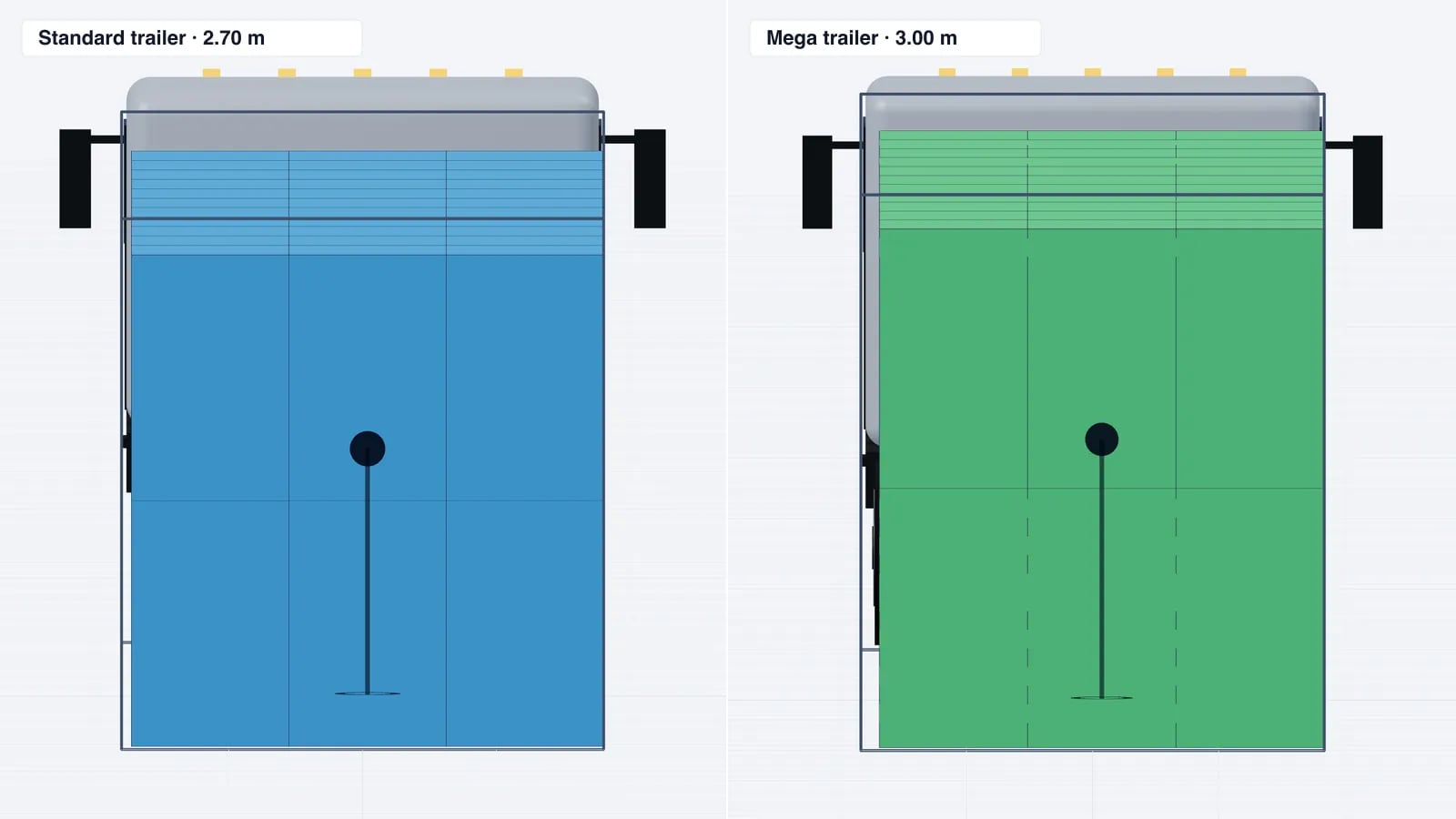
A mega trailer is a 13.6 m semitrailer with about 3.0 m of internal height instead of the 2.6–2.75 m of a standard trailer, giving roughly 100 m³ instead of 90 m³. It pays when your cargo is light and tall enough that the extra 25–35 cm lets you double-stack pallets or fit high goods you would otherwise send on two trucks.
For dense cargo the mega gives you nothing: you hit the payload long before you run out of height. The decision is therefore less about the trailer and more about your cargo density and pallet heights.
How a mega trailer gets its height
In most EU countries the whole vehicle may be at most 4.0 m high, so the extra internal height has to come from below. A mega trailer has a lowered deck, roughly 0.9–1.0 m above the road instead of 1.1–1.2 m, running on smaller low-profile wheels (often 19.5-inch). It is pulled by a low-deck tractor whose fifth wheel sits lower than a standard tractor's.
Many megas also have a gooseneck at the front, where the floor steps up over the fifth wheel, so the first metre or so of floor may have less height than the rest. Check the trailer drawing: a pallet that fits at the back may not fit at the front wall.
Mega vs standard at a glance
Internal length × width
- Standard trailer
- 13.6 × 2.45–2.48 m
- Mega trailer
- 13.6 × 2.45–2.48 m
Internal height
- Standard trailer
- 2.6–2.75 m
- Mega trailer
- 2.95–3.0 m (may be lower over the gooseneck)
Volume
- Standard trailer
- about 88–92 m³
- Mega trailer
- about 98–101 m³
Euro pallets on the floor
- Standard trailer
- 33
- Mega trailer
- 33
Typical payload
- Standard trailer
- 24–25 t
- Mega trailer
- 23–25 t, depending on build
Tractor
- Standard trailer
- standard
- Mega trailer
- low-deck (low fifth-wheel height)
Deck height
- Standard trailer
- about 1.1–1.2 m
- Mega trailer
- about 0.9–1.0 m
| Standard trailer | Mega trailer | |
|---|---|---|
| Internal length × width | 13.6 × 2.45–2.48 m | 13.6 × 2.45–2.48 m |
| Internal height | 2.6–2.75 m | 2.95–3.0 m (may be lower over the gooseneck) |
| Volume | about 88–92 m³ | about 98–101 m³ |
| Euro pallets on the floor | 33 | 33 |
| Typical payload | 24–25 t | 23–25 t, depending on build |
| Tractor | standard | low-deck (low fifth-wheel height) |
| Deck height | about 1.1–1.2 m | about 0.9–1.0 m |
Good to know
Values are typical and vary by manufacturer. Always check the specific trailer, especially the height at the gooseneck and under the rear door frame.
When the extra height pays
The useful question is: does 30 cm turn one layer into two? Two pallets stacked need their combined height plus a few centimetres of clearance for the forklift to set the top one down. Planning with about 5 cm of clearance:
- Standard trailer, 2.70 m inside: two pallets up to about 1.32 m each can be double-stacked.
- Mega trailer, 3.00 m inside: two pallets up to about 1.47 m each can be double-stacked.
So a mega pays most when your pallets are between about 1.33 m and 1.47 m high, light enough that 66 of them stay inside the payload, and strong enough to carry a second pallet. That band covers a lot of automotive parts in racks, packaging, insulation, e-commerce cartons, furniture components and consumer goods.
It also pays for single items between 2.7 m and 3.0 m high, such as tall machinery, rolled goods on end or racks, which simply do not fit in a standard trailer.
Worked example: 52 pallets of packaging
Say a customer ships 52 Euro pallets of empty plastic containers, each 1.40 m high and 180 kg.
- 1Standard trailer: 1.40 + 1.40 = 2.80 m, too tall for 2.70 m. Single-stacked, 33 pallets fit, so you need two trucks (33 + 19).
- 2Mega trailer: 2.80 m plus clearance fits under 3.00 m. 26 floor positions double-stacked hold 52 pallets, so one truck carries the whole order.
- 3Floor used: 26 positions × 0.4 = 10.4 loading metres of 13.6 m.
- 4Weight: 52 × 180 = 9,360 kg, far below payload, so weight is not the limit.
Here the mega halves the number of trips. If those pallets were 1.25 m high, a standard trailer would double-stack them just as well, and the mega would bring no benefit.
The downsides to weigh up
- Equipment: you need a low-deck tractor, and not every subcontractor has one. Megas can cost more to hire.
- Docks: with a deck around 1.0 m, the trailer sits below many loading docks, so the site needs dock levellers with enough range.
- Tyres and clearance: smaller wheels wear faster and the lower chassis has less ground clearance on ramps and rough yards.
- Payload: some mega builds are slightly heavier, so check payload when the load is mixed with dense goods.
- Height rules: within the EU, 4.0 m is the common limit, but routes, ferries, tunnels and bridges can be stricter. Check the whole route, especially outside your usual network.
Mega trailers and weight distribution
Because megas are used for light cargo, weight is rarely the problem, but balance can be. A double-stacked block of light pallets at the front and a few dense items at the doors gives an uneven load, and the lower deck does not change the axle limits. Plan dense items near the middle of the floor and check the axle estimate as you would on any trailer. Taller stacks also mean a higher centre of gravity, so keep heavy pallets on the bottom layer and lighter ones on top; see centre of gravity of a load.
How to decide for a regular flow
- 1Pull a few weeks of shipments and note pallet heights and weights.
- 2Count how many loads would double-stack in a mega but not in a standard trailer (pallets roughly 1.33–1.47 m high and stackable).
- 3Check those loads stay within payload when double-stacked; see double stacking pallets in trailers.
- 4Compare the trips saved with the extra cost of megas and low-deck tractors on that lane.
Tip
You can test both quickly: plan the load in a standard trailer in EveryLoading, then switch the vehicle to a mega trailer preset and press Optimize load again. The stats bar shows volume, weight and anything that did not fit for each.
For the base dimensions of each trailer type, see semi trailer dimensions. For how stacking limits should be set per item, see pallet stacking rules.
Frequently asked questions
What is the difference between a mega trailer and a standard trailer?
Both have a 13.6 m floor that takes 33 Euro pallets. The mega has about 3.0 m of internal height instead of 2.6–2.75 m, gained by a lower deck and smaller wheels.
Do I need a special tractor for a mega trailer?
Yes, normally a low-deck tractor with a lower fifth wheel. A standard tractor would lift the trailer and push the vehicle above the 4.0 m height limit used in most EU countries.
Can a mega trailer carry more weight?
No. Its payload is similar to or slightly below a standard trailer. The gain is volume and height, which only helps light, bulky cargo.
How high can double-stacked pallets be in a mega trailer?
Allowing a few centimetres of clearance, two pallets up to about 1.47 m each in a 3.0 m trailer. Check the lower height over the gooseneck if the trailer has one.
Keep reading
Road freight · · 5 min read
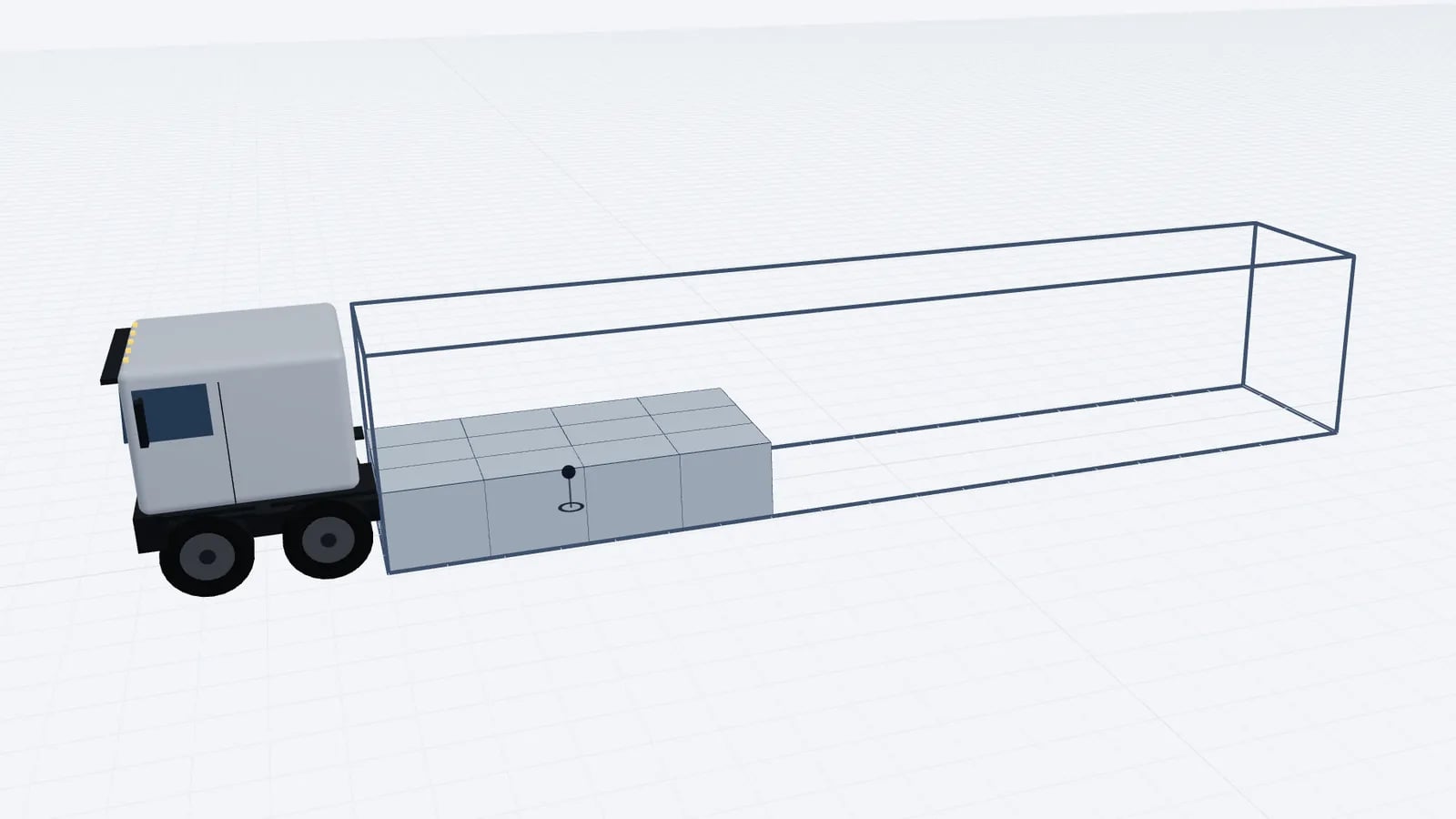
Semi Trailer Dimensions: Curtainsider, Mega, Reefer and Box
Internal length, width, height and typical payload of the 13.6 m curtainsider, mega trailer, reefer and box trailer, with pallet counts and planning tips.
Read article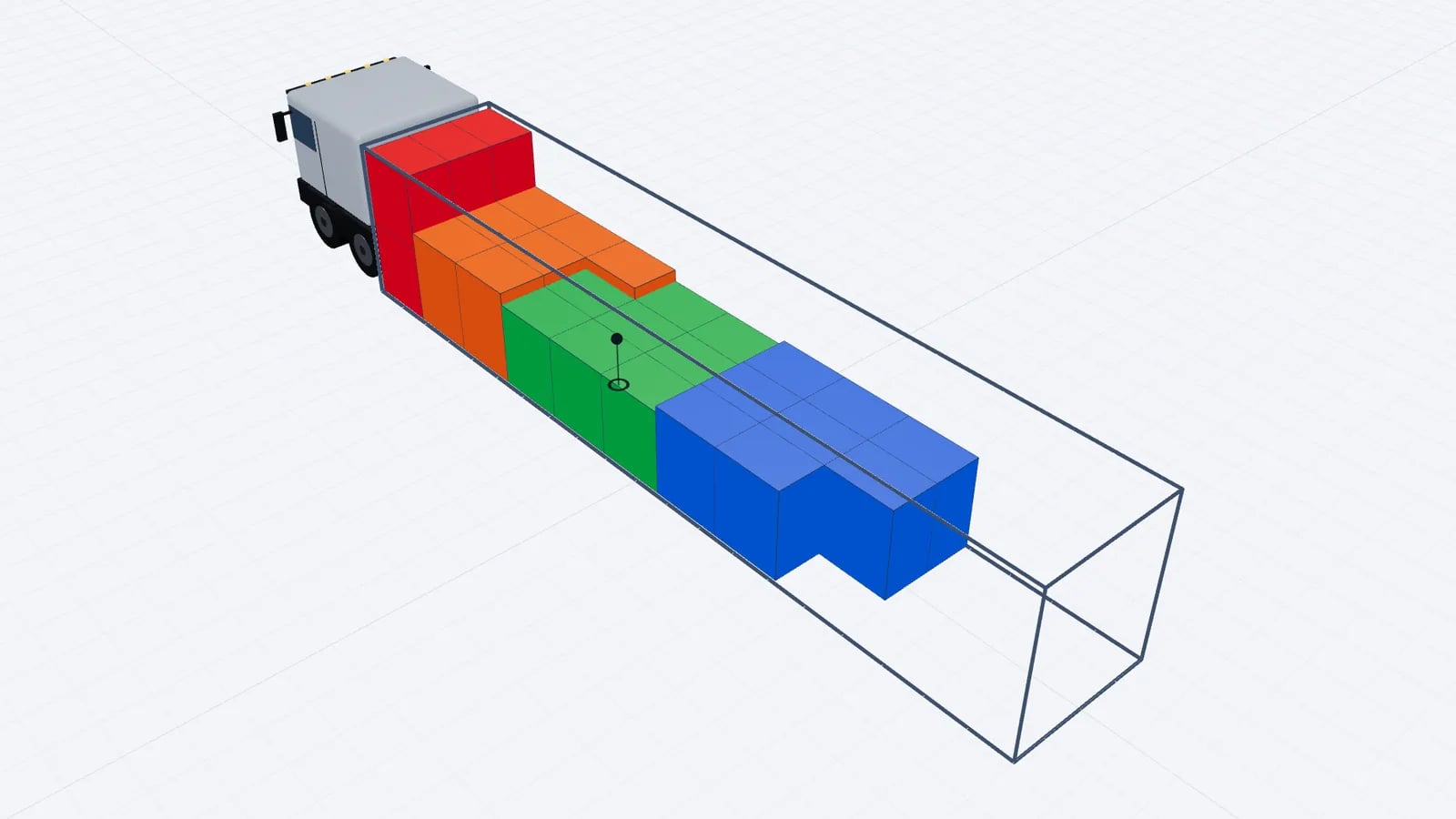
Road freight · · 5 min read
Multi Drop Loading: How to Plan a Truck for Several Stops
Plan a multi-drop truck so every stop unloads without moving other cargo: LIFO order, lanes, stop numbers, axle loads after each drop and a worked example.
Read article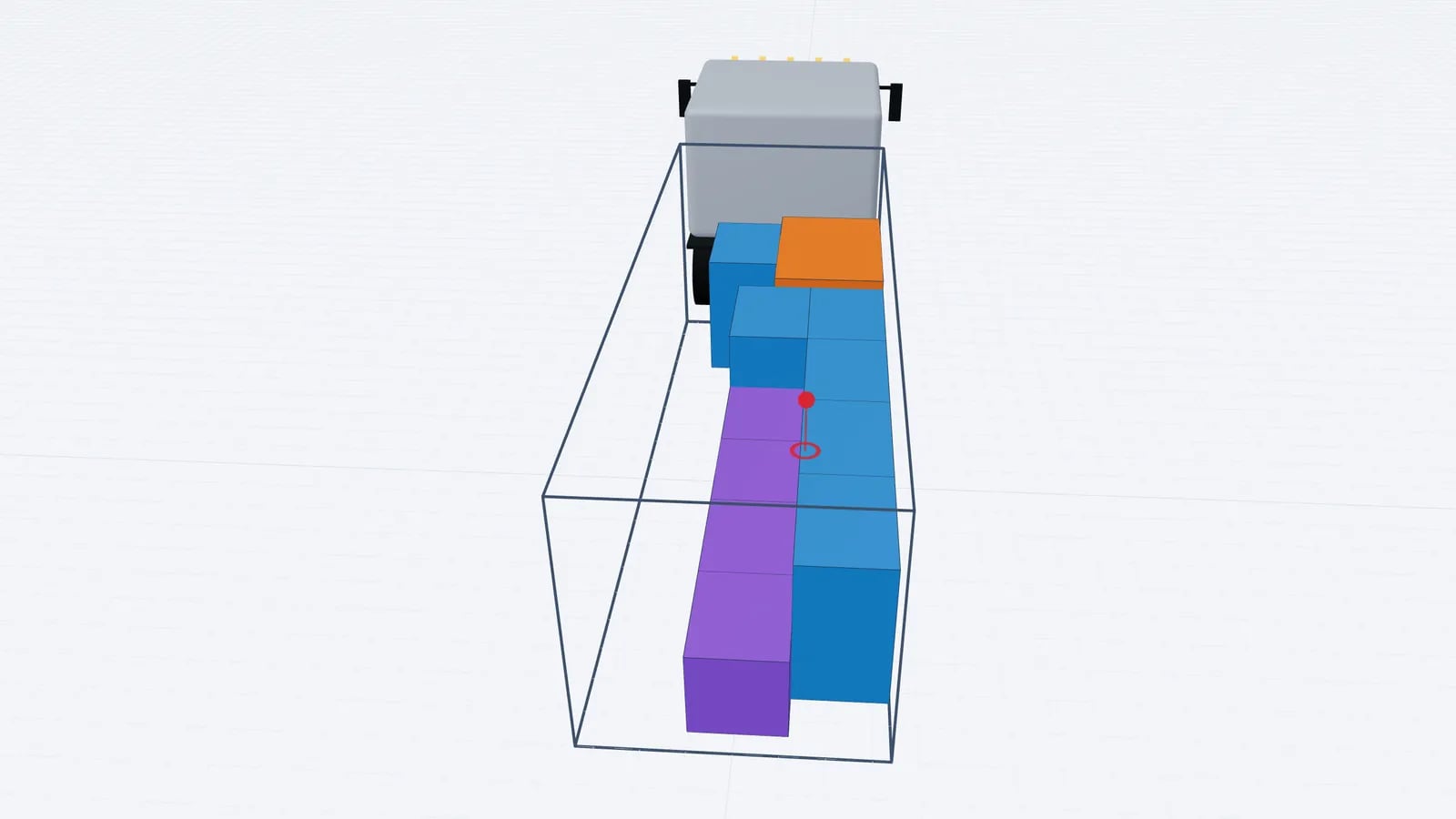
Road freight · · 5 min read
Load Securing Basics: EN 12195-1, Friction, Lashing, Blocking
The principles of load securing under EN 12195-1: design forces, friction, blocking, lashing, body strength, and how a gap-free load plan cuts securing effort.
Read article