Shipping Container Dimensions: 20', 40', 40' HC and 45' HC
Internal size, door openings, tare, payload and cubic capacity of 20', 40', 40' high cube and 45' containers, with the limits that matter when you plan a load.
Sea containers · · 6 min read
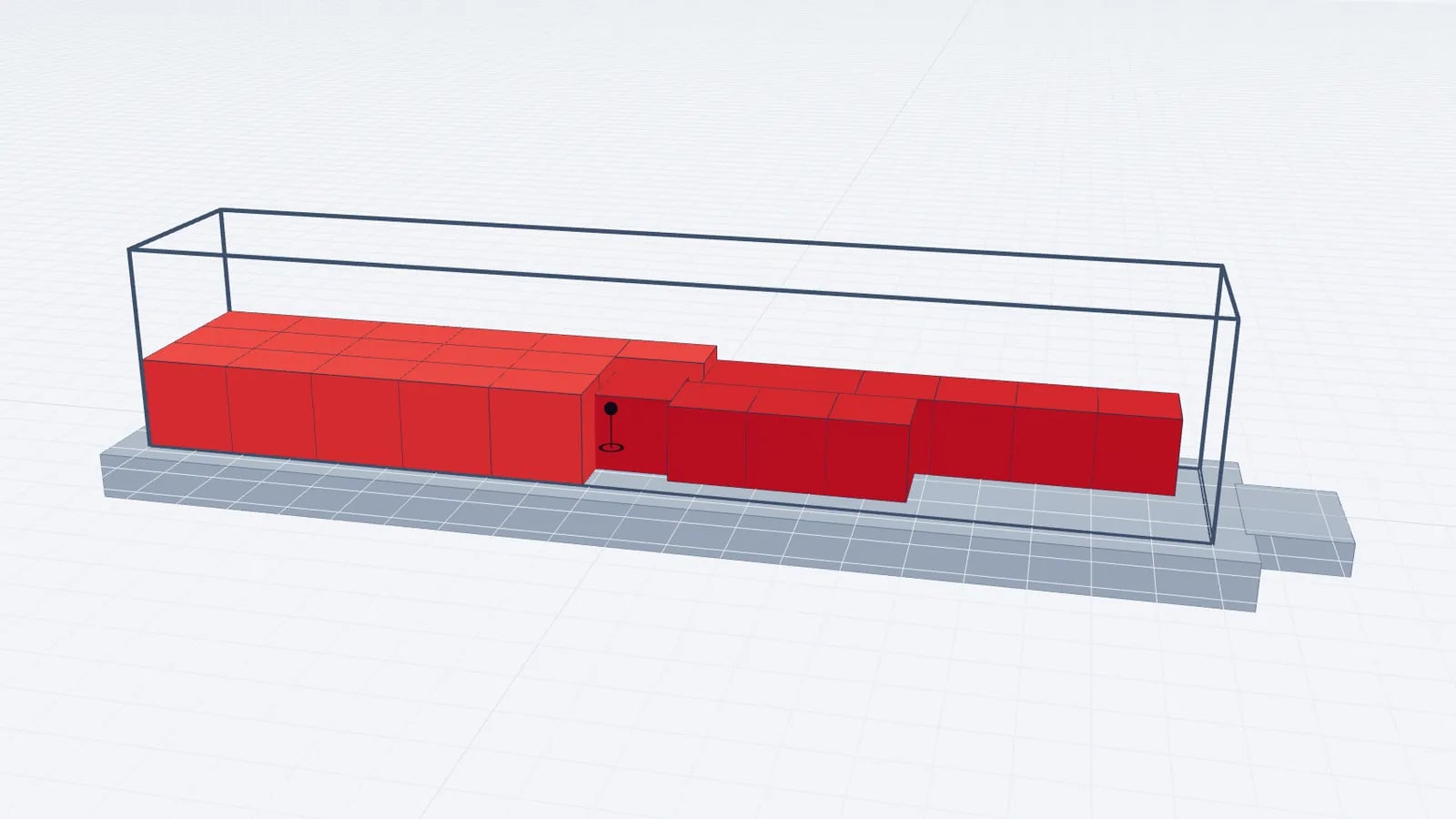
A standard 20' dry container measures about 5.90 × 2.35 × 2.39 m inside (roughly 33 m³), a 40' about 12.03 × 2.35 × 2.39 m (roughly 68 m³), and a 40' high cube about 12.03 × 2.35 × 2.70 m (roughly 76 m³). All share an internal width of about 2.35 m, and the door opening is always smaller than the inside, which is what limits tall loads.
The figures below are typical values for steel dry containers. Every box is slightly different, so for a tight load always check the CSC plate and the markings on the door of the actual container you are given.
Container dimensions at a glance
Type: 20' standard
- Inside L × W × H
- 5.90 × 2.35 × 2.39 m
- Door W × H
- 2.34 × 2.28 m
- Capacity
- 33.2 m³
- Typical tare
- 2,200–2,300 kg
- Typical max payload
- ≈ 28,000 kg
Type: 40' standard
- Inside L × W × H
- 12.03 × 2.35 × 2.39 m
- Door W × H
- 2.34 × 2.28 m
- Capacity
- 67.7 m³
- Typical tare
- 3,700–3,800 kg
- Typical max payload
- ≈ 26,600–28,700 kg
Type: 40' high cube
- Inside L × W × H
- 12.03 × 2.35 × 2.70 m
- Door W × H
- 2.34 × 2.58 m
- Capacity
- 76.3 m³
- Typical tare
- 3,900–4,000 kg
- Typical max payload
- ≈ 26,500–28,600 kg
Type: 45' high cube
- Inside L × W × H
- 13.56 × 2.35 × 2.70 m
- Door W × H
- 2.34 × 2.58 m
- Capacity
- 86.0 m³
- Typical tare
- 4,700–4,900 kg
- Typical max payload
- ≈ 27,600 kg
| Type | Inside L × W × H | Door W × H | Capacity | Typical tare | Typical max payload |
|---|---|---|---|---|---|
| 20' standard | 5.90 × 2.35 × 2.39 m | 2.34 × 2.28 m | 33.2 m³ | 2,200–2,300 kg | ≈ 28,000 kg |
| 40' standard | 12.03 × 2.35 × 2.39 m | 2.34 × 2.28 m | 67.7 m³ | 3,700–3,800 kg | ≈ 26,600–28,700 kg |
| 40' high cube | 12.03 × 2.35 × 2.70 m | 2.34 × 2.58 m | 76.3 m³ | 3,900–4,000 kg | ≈ 26,500–28,600 kg |
| 45' high cube | 13.56 × 2.35 × 2.70 m | 2.34 × 2.58 m | 86.0 m³ | 4,700–4,900 kg | ≈ 27,600 kg |
Payload is simply maximum gross mass minus tare. Older boxes are commonly rated at 30,480 kg gross; many newer 40' units are rated at 32,500 kg, which is why the payload column shows a range. The 20' payload is higher than the 40' payload on many boxes because the gross rating is similar while the 20' weighs less empty.
External dimensions and ISO 668
Container outside dimensions are standardised in ISO 668. All the common types are 2.438 m (8 ft) wide outside. Standard boxes are 2.591 m (8 ft 6 in) high and high cubes 2.896 m (9 ft 6 in). Lengths are 6.058 m for a 20', 12.192 m for a 40' and 13.716 m for a 45'.
The outside size matters for road and rail: a high cube on a standard chassis can exceed the 4 m height limit that applies in many European countries, so carriers may need low chassis or route checks. For the load plan itself, only the inside matters.
Why the door opening is the real height limit
The door frame and header take about 11 cm off the internal height. A 40' high cube has roughly 2.70 m inside but only about 2.58 m at the door. Anything that has to pass through the doors in one piece, such as a double-stacked pallet on a forklift, must be lower than the door, not the ceiling.
Say you want to double-stack pallets that are each 1.32 m tall. The stack is 2.64 m: lower than the 2.70 m ceiling, but higher than the 2.58 m door, so it cannot be driven in as a pair. You would have to place the bottom pallets first and lift the top pallets on inside the box, which most forklifts cannot do near the ceiling. Keep double stacks in a high cube to around 2.50–2.55 m including the pallet bases, and in a standard box to around 2.20 m.
Tip
Door width (about 2.34 m) is almost the full internal width, so it rarely limits pallets. It does matter for wide crates and machinery: anything over roughly 2.30 m wide needs an open-top or flat-rack instead.
Floor area and what it means for pallets
Type: 20'
- Floor area
- 13.9 m²
- Euro pallets (1200×800), one tier
- 11
- Industrial pallets (1200×1000), one tier
- 9
Type: 40' / 40' HC
- Floor area
- 28.3 m²
- Euro pallets (1200×800), one tier
- 24–25
- Industrial pallets (1200×1000), one tier
- 20–21
Type: 45' HC (2.35 m wide)
- Floor area
- 31.9 m²
- Euro pallets (1200×800), one tier
- 27
- Industrial pallets (1200×1000), one tier
- 24
| Type | Floor area | Euro pallets (1200×800), one tier | Industrial pallets (1200×1000), one tier |
|---|---|---|---|
| 20' | 13.9 m² | 11 | 9 |
| 40' / 40' HC | 28.3 m² | 24–25 | 20–21 |
| 45' HC (2.35 m wide) | 31.9 m² | 27 | 24 |
The internal width of about 2.35 m is the awkward number. It is too narrow for two pallets side by side on their 1.2 m side (2.40 m) and leaves 75 cm unused if you put two Euro pallets on their 0.8 m side. The full pallet arithmetic, including mixed-lane layouts, is in how many pallets fit in a container. Some 45' boxes are built "pallet-wide" with about 2.44 m inside, which takes 33 Euro pallets.
Weight limits versus volume limits
Each container type has a cargo density at which you hit the weight limit and the volume limit at the same time. Divide payload by capacity: for a 20' that is about 28,000 kg / 33.2 m³ ≈ 840 kg/m³; for a 40' about 26,700 kg / 67.7 m³ ≈ 395 kg/m³; for a 40' high cube about 26,500 kg / 76.3 m³ ≈ 345 kg/m³.
- Dense cargo (tiles, metal parts, bagged chemicals, drinks) runs out of weight long before space. A 20' is usually the better box; a 40' only adds empty air.
- Light cargo (furniture, textiles, plastics, empty packaging) runs out of space first. A 40' or 40' high cube gives the lowest cost per cubic metre.
- Road limits at origin and destination may cap the payload below the container rating. Check the gross vehicle weight allowed for container chassis on both legs before you plan to the full payload.
The trade-offs between box sizes are covered in 20ft vs 40ft container. Reefer containers have thicker insulated walls and are noticeably smaller inside; see reefer container loading.
Worked example: which container for this shipment?
Say you are shipping 30 crates of 1.10 × 0.95 × 1.00 m, 420 kg each, not stackable. Total volume is 30 × 1.045 m³ = 31.35 m³ and total weight is 12,600 kg.
- 1Volume check: 31.35 m³ is just under the 33.2 m³ of a 20', but that box is a theoretical maximum. Non-stackable crates use only the floor, so volume is the wrong test here.
- 2Floor check: each crate covers 1.10 × 0.95 = 1.045 m². Two fit across the 2.35 m width (2 × 1.10 = 2.20 m). Along the 5.90 m length of a 20' you get 6 rows of 0.95 m (5.70 m), so 12 crates. Along the 12.03 m of a 40' you get 12 rows (11.40 m), so 24 crates.
- 3Result: 30 crates need either a 40' (24) plus a 20' (6) remaining, or two 20' (24) plus a few left over, or one 45' (13.56 m / 0.95 = 14 rows, 28 crates) plus a remainder. Weight is not the constraint: even 30 crates are well under any payload.
- 4Decision: in this hypothetical case the cheapest option depends on freight rates, but the plan shows the decision is about floor space, not cubic metres.
This is exactly where a quick 3D plan saves time. In EveryLoading you can pick the 20', 40', 40' HC, 45' HC or reefer preset, paste the crate list and see in seconds how many fit and what is left over. The vehicle settings guide explains how to adjust the inside dimensions to match a specific box.
Practical checks before you rely on the numbers
- Read the CSC plate and door markings for max gross, tare and payload of the actual box; don't plan to the brochure figure if you are within a few hundred kilograms.
- Allow 5–10 cm of length for door closing and pallet overhang; a plan that fits to the last millimetre on paper often does not at the dock.
- Corrugated side walls take a centimetre or two off the usable width at the corrugations; pallets with overhanging cartons can catch.
- Check the floor rating if you have heavy point loads; container floors are designed for forklift traffic, but concentrated loads such as machine feet need spreading timber.
- Remember the VGM: the gross mass you declare includes cargo, packaging, dunnage and the tare. See VGM and SOLAS.
Frequently asked questions
What are the internal dimensions of a 40ft high cube container?
Typically about 12.03 m long, 2.35 m wide and 2.70 m high inside, giving around 76 m³. The door opening is about 2.34 m wide and 2.58 m high.
Is a 40ft container twice the payload of a 20ft?
No. It has roughly twice the volume, but the maximum gross weight is similar, so the payload of a 40' is often lower than a 20' because the empty box weighs more.
Why does my double-stacked pallet fit inside but not through the door?
The door header is about 11 cm lower than the internal ceiling. Stacks loaded as a pair by forklift must be lower than the door height, not the internal height.
Where do I find the exact tare and payload of my container?
On the CSC safety approval plate and the markings painted on the container doors. These figures belong to that specific box and override any typical value.
Keep reading
Sea containers · · 5 min read
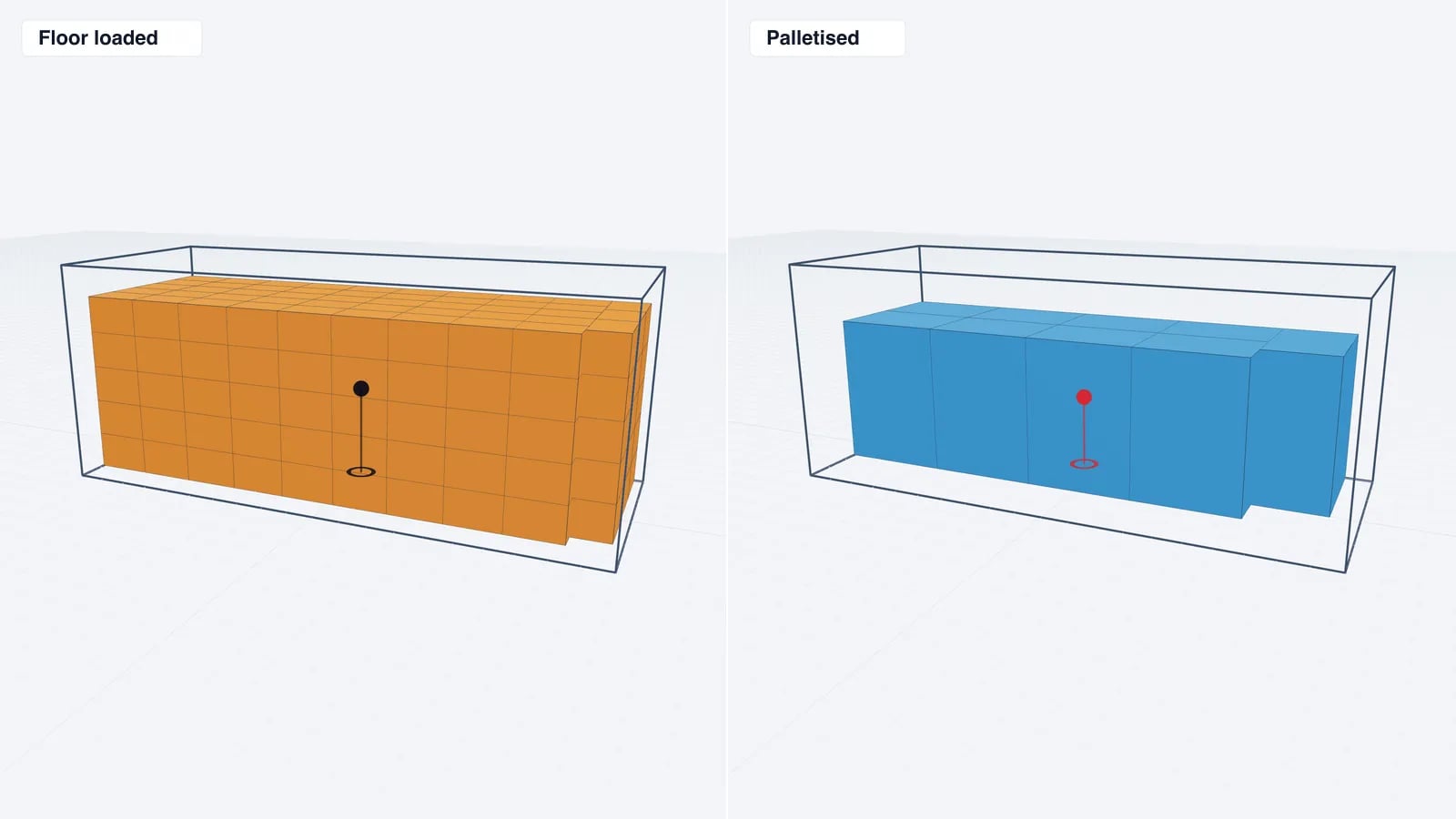
Floor Loading Cartons in a Container vs Palletised Loads
When to floor load cartons instead of palletising, how to orient and stack them, how to check carton strength, and a worked 40ft high cube comparison.
Read article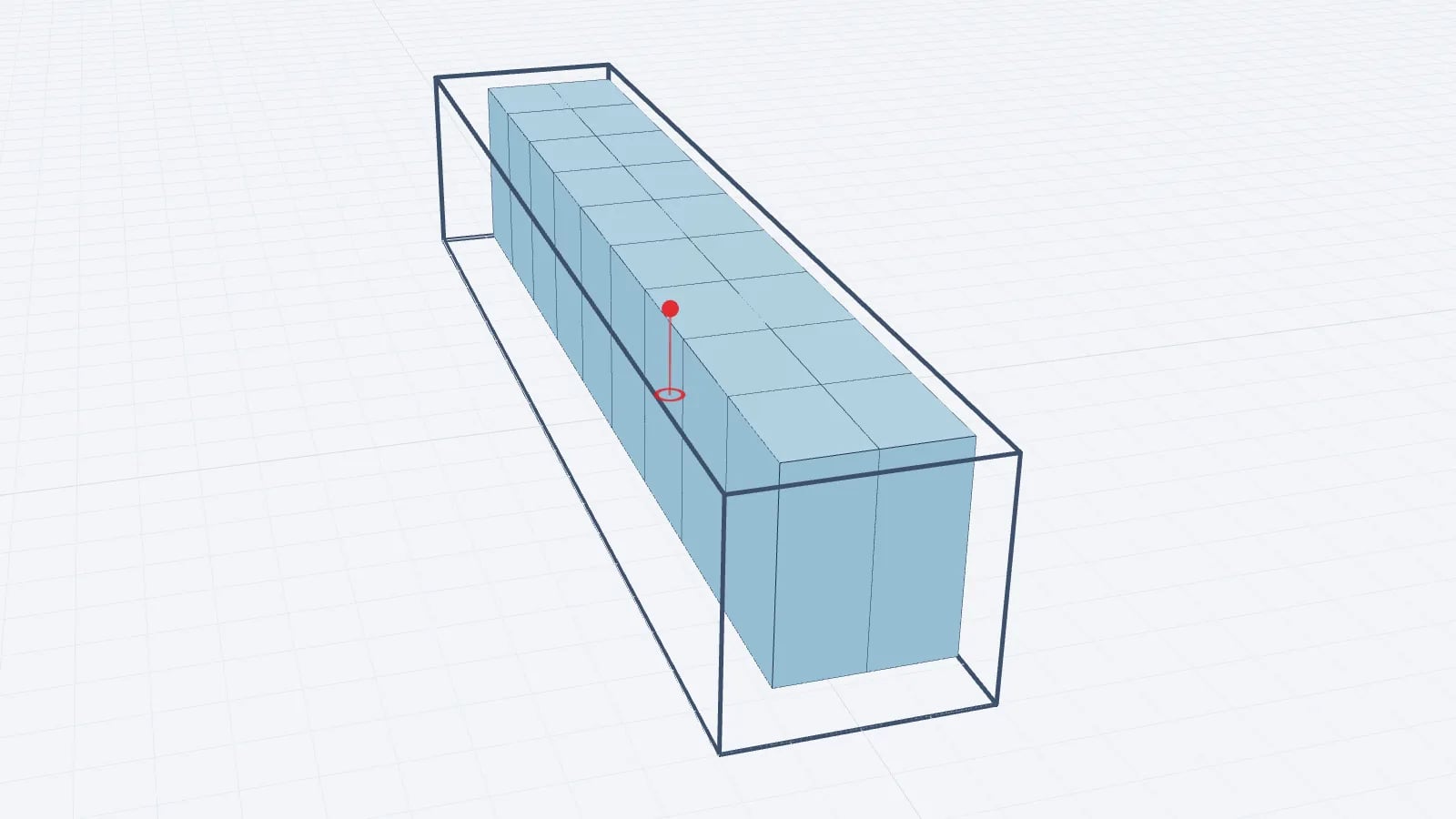
Sea containers · · 5 min read
Reefer Container Loading: Airflow, Red Line and Pallet Plans
How reefers move air, why the T-floor and red load line limit your plan, chilled vs frozen stowage, pre-cooling, and a worked 40ft reefer pallet plan.
Read article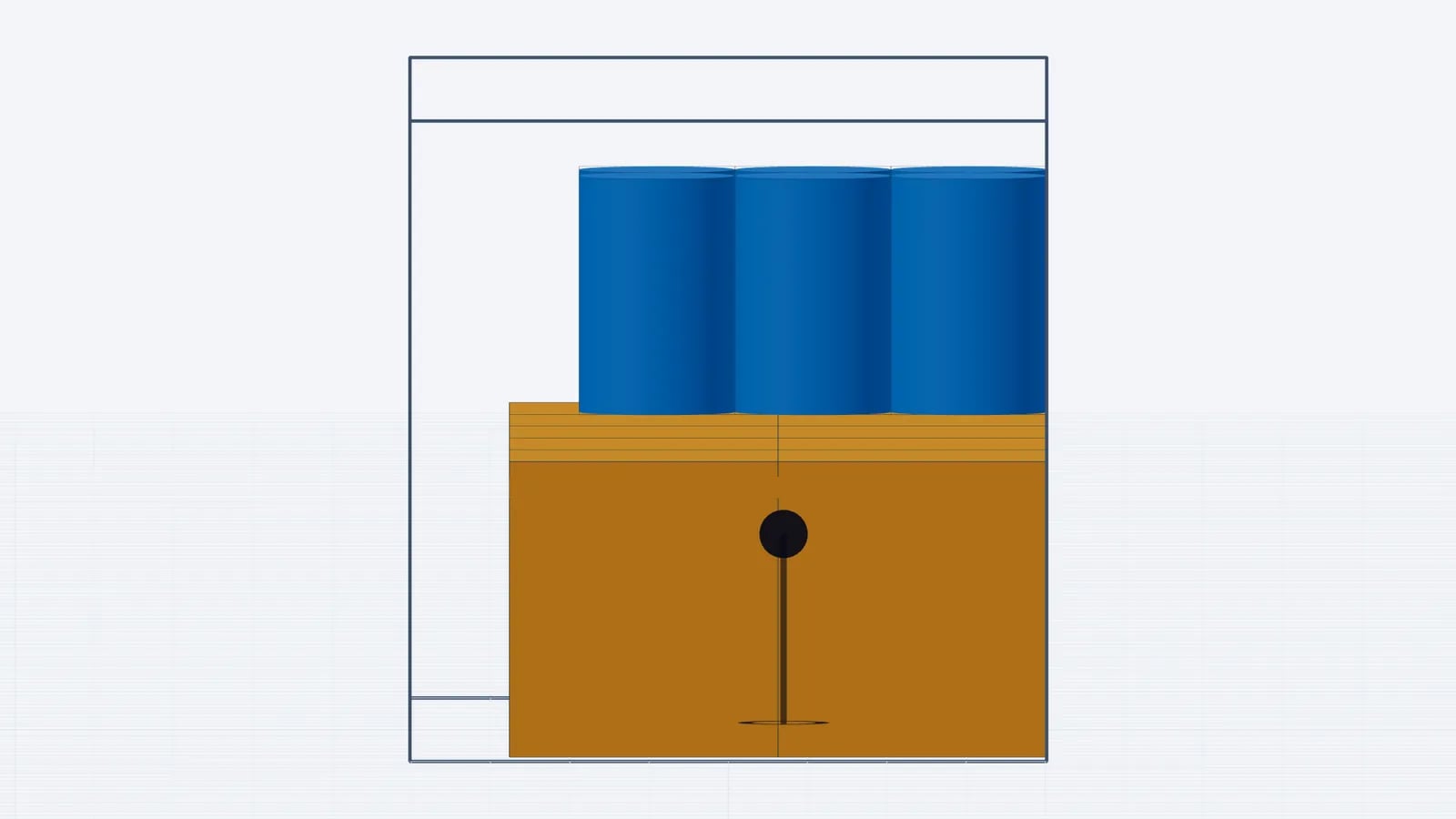
Sea containers · · 6 min read
Container Dunnage: Airbags, Blocking, Bracing and Void Fill
How to secure container cargo with airbags, timber blocking, bracing, lashing and void fill, and how to plan the load so there are fewer gaps to fill.
Read article